
Which figure should replace the question mark (?) if the following series were to be continued?
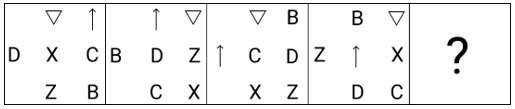
- (a)
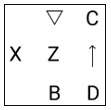
- (b)
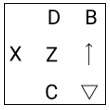
- (c)
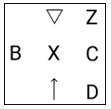
- (d)
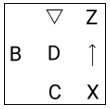
Answer
Why
Correct — D. Rule: the moves alternate — figure 1 to 2 makes the same change as figure 3 to 4, so figure 4 to the answer repeats the change from figure 2 to 3.
That change is two rotations running at once.
Top loop: top-centre goes to mid-left, mid-left to top-right, top-right to top-centre.
Lower-right 2×2 block (mid-centre, mid-right, bottom-centre, bottom-right) turns one place clockwise.
Figure 4 reads B ▽ on top, Z ↑ X across the middle, D C below. The top loop sends ▽ to top-centre, Z to top-right and B to mid-left. The block sends D to mid-centre, ↑ to mid-right, X to bottom-right and C to bottom-centre.
That gives ▽ Z on top, B D ↑ across the middle and C X below — option (d).
Why the others are wrong
- (a)It puts ▽ and ↑ in the right cells and then scrambles the letters. Its 2×2 block holds Z and B, which were nowhere near that block in figure 4, and a turn cannot import a symbol from outside itself.
- (b)Its ▽ sits at bottom-right. In all four given figures ▽ stands in the top row, and neither of the two rotations moves anything from the top row down to the bottom one.
- (c)It gets the top three cells right — ▽, Z, B — but turns the 2×2 block anticlockwise: mid-centre to bottom-centre, bottom-centre to bottom-right. Figure 2 to 3 turns that block the other way.
Concept
A figure series whose cells never change shape is a permutation puzzle. The same seven symbols occupy the same seven cells in every box, and only the arrangement moves.
Do not force one rule onto every step. When 1 to 2 and 3 to 4 agree with each other but not with 2 to 3, the series is alternating, and the missing box repeats the even step.
Work symbol by symbol rather than picture by picture. Note where each of ▽, ↑, B, C, D, X and Z stands in figures 2 and 3, and the two loops fall out — a three-cell loop across the top and a four-cell turn in the lower-right block.
The empty cells are the top-left and bottom-left, in every box.
A fixed set of filled cells is the signal that nothing is being added or removed and the answer is a rearrangement.
Key facts
- The same seven cells are filled in every figure, so only the arrangement changes.
- Figure 1 to 2 and figure 3 to 4 apply the same movement.
- Figure 2 to 3 rotates top-centre, mid-left and top-right, and turns the lower-right 2×2 block clockwise.
- ▽ stands in the top row in all four given figures.
Study next
Common traps
- Forcing one rule onto every step and then picking whichever option is nearest
- Turning the 2×2 block the wrong way round, which lands you on option (c)
- Reading the grids row by row instead of tracking where each symbol goes
Four grids and a question mark are printed, and the figure that continues the series is asked for. The same stem is used at 09 Sep 2024, 16:00, Reasoning Q.22 and at 11 Sep 2024, 12:30, Reasoning Q.15.
Related PYQs
No directly related past PYQ was found.