
The sequence of folding a piece of paper and the manner in which the folded paper has been cut is shown in the following figures. How would this paper look when unfolded?
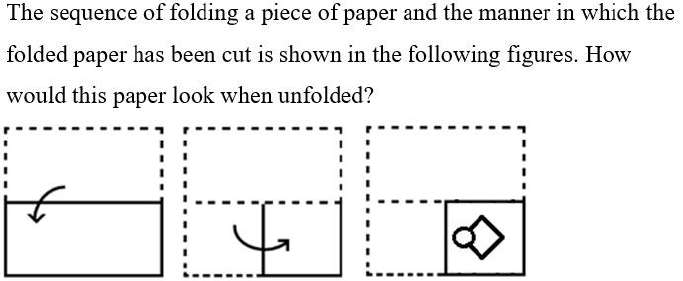
- (a)
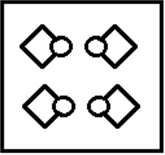
- (b)
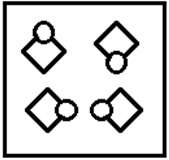
- (c)
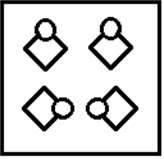
- (d)
Answer
Why
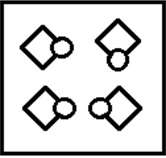
Correct — A. Rule: unfolding reflects the cut across each crease, in reverse order — undo the last fold first.
The sheet is folded top half down, then left half right, so the cut is made in the bottom-right quadrant through all four layers. It is a diamond with a small circle at its left point.
Undo the vertical crease: the bottom-left quadrant receives a mirrored copy, its circle now on the right of the diamond.
Undo the horizontal crease: the top half repeats the bottom half, the circle staying at the same side and height. Option (a) shows exactly that — circle on the right in both left-hand quadrants, on the left in both right-hand ones.
Why the others are wrong
- (b)Its two upper cuts put the circle at the diamond's top and bottom points. Reflecting a cut across a horizontal crease keeps it at the same side of the diamond and never turns it a quarter-turn.
- (c)Its top row repeats one motif, circle above the diamond in both quadrants. The vertical crease forces the two halves of a row to face opposite ways, so they cannot match.
- (d)Its top-right circle hangs below the diamond. The cut sits at a left or right point, and reflecting across either crease leaves it at a left or right point.
Concept
Fold-and-cut is reflection, done backwards.
Each fold halves the sheet, so two folds make four layers and a single cut opens out into four copies.
Unfold in reverse order. Undo the last crease first, mirroring the cut across it, then undo the earlier crease, mirroring everything you now have across that one.
The direction of each mirror is where candidates lose the mark. A vertical crease swaps left and right and leaves heights untouched. A horizontal crease swaps top and bottom and leaves the left-right position untouched.
The three panels of the stem are legible and carry the fold arrows clearly, so the folded quadrant can be read straight off the page.
The cut lands in the bottom-right quadrant, which fixes where the original motif must appear in the answer.
Key facts
- Two folds give four layers, so one cut opens out into four identical shapes.
- Unfolding is done in reverse order, the last fold undone first.
- A vertical crease mirrors left to right and does not change a shape's height.
- A horizontal crease mirrors top to bottom and does not change a shape's distance from the side.
Study next
Common traps
- Copying the cut without mirroring it, so all four copies face the same way
- Undoing the folds in the order they were made
- Rotating the motif where the crease calls for a reflection
Here the folds are drawn as dashed outlines with curved arrows, the cut is shown on the final folded piece, and the opened sheet is asked for. The same stem is set at 19 Sep 2024, 16:00, Reasoning Q.23.
Related PYQs
No directly related past PYQ was found.