
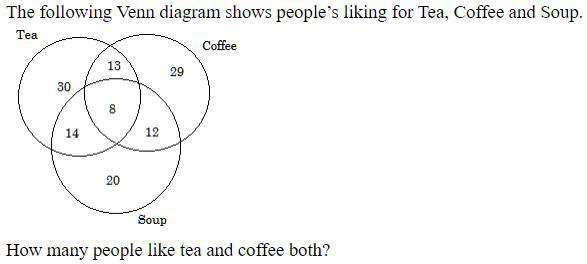
The following Venn diagram shows people’s liking for Tea, Coffee and Soup. Tea only 30 | Tea and Coffee 13 | Coffee only 29 | Tea, Coffee and Soup 8 | Tea and Soup 14 | Coffee and Soup 12 | Soup only 20 How many people like tea and coffee both?
- (a)43
- (b)13
- (c)29
- (d)21
Answer
Why
Correct — D. The figure carries the question: a three-circle Venn diagram for Tea, Coffee and Soup, asking how many people like tea and coffee both.
Rule: both means every region inside both circles, whether or not soup is also liked.
Two regions qualify — the 13 in the tea-coffee overlap that lies outside soup, and the 8 at the centre where all three circles meet.
13 + 8 = 21, which is option (d).
Why the others are wrong
- (a)43 — 43 is 30 + 13, the tea-only region added to the overlap. Those 30 sit outside the coffee circle altogether, so they cannot count as liking both.
- (b)13 — 13 answers a different question — tea and coffee but not soup. The stem carries no such rider, so the central 8 has to be added in.
- (c)29 — 29 is the coffee-only region, lying outside the tea circle entirely. It answers 'coffee alone', not 'tea and coffee'.
Concept
A three-circle Venn diagram has seven regions, and the entire skill is deciding which of them a phrase covers.
'Tea and coffee both' is an intersection: every region inside the tea circle and inside the coffee circle. That is the two-way overlap plus the centre.
'Tea and coffee only', or 'tea and coffee but not soup', would drop the centre. One word moves the answer by the size of the central region, which is why these questions are read twice before they are counted.
Totals follow the same discipline: everyone who likes tea is 30 + 13 + 8 + 14 = 65.
The diagram is fully numbered, so nothing has to be deduced.
Every mark here is lost in the reading of the phrase, not in the arithmetic.
Key facts
- In this diagram 13 people like tea and coffee but not soup, and 8 like all three.
- People liking both tea and coffee therefore number 13 + 8 = 21.
- The tea circle holds 30 + 13 + 8 + 14 = 65 people altogether.
- The word 'only' in a Venn question excludes the central region.
Study next
Common traps
- Answering 13 because the central 8 was mentally handed to soup
- Adding the tea-only region to the overlap
- Reading 'both' as though it meant 'these two and nothing else'
Here every region is already numbered and one counting question is asked in words, so the work is in the phrasing rather than the arithmetic. Reasoning Q.9 of this paper turns on the word only in the same way.
Related PYQs
No directly related past PYQ was found.