
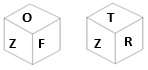
Six letters O, Z, F, T, R and M are written on different faces of a dice. Two positions of this dice are shown in the figures below. Find the letter on the face opposite to Z.
- (a)M
- (b)T
- (c)R
- (d)F
Answer
Why
Correct — A. Read the two views off the figure. The first die shows O on top, Z on the left face and F on the right. The second shows T on top, Z on the left face and R on the right.
Rule: two letters visible in the same view sit on adjacent faces, so neither can be opposite the other.
From view 1, Z is adjacent to O and F.
From view 2, Z is adjacent to T and R.
Z therefore has four known neighbours: O, F, T and R. A cube face has exactly four neighbours and one opposite, so the letter never seen beside Z, M, is the one facing away from it — option (a).
Why the others are wrong
- (b)T — T sits on the top face of the second die while Z sits on its left face. The two are visible together, so they are adjacent and cannot be opposite.
- (c)R — R is on the right face of the second die with Z on its left face in the same view, which makes R adjacent to Z.
- (d)F — F is on the right face of the first die with Z on its left face in the same view, which makes F adjacent to Z.
Concept
A cube has six faces in three opposite pairs. Every face touches four others and turns its back on exactly one.
That gives the fastest dice method there is: find a letter that appears in more than one view, collect everything ever pictured beside it, and stop when you have four neighbours. The remaining letter is its opposite.
No rotation is needed and no orientation has to be reconstructed.
Only two views are supplied, so the die's full arrangement cannot be recovered — the opposite pairs among O, F, T and R stay unknown. The question does not need them, because Z alone collects all four of its neighbours across the two pictures.
Key facts
- Each face of a cube is adjacent to four faces and opposite exactly one.
- Two letters shown together in one view can never be on opposite faces.
- Z is pictured beside O, F, T and R across the two views, which leaves M as the only face it never touches.
Study next
Common traps
- Stopping after one view, where Z has only two known neighbours and three letters are still in play
- Assuming the letter common to both views is itself the answer, when Z is the anchor rather than the opposite face
- Trying to rotate the die into a shared orientation when the adjacency count already settles it
The stem prints two views with one face repeated, so adjacency alone decides it. The same stem is set on 23 Sep 2024, 09:00, Reasoning Q.9 (letters P, J, U, W, L, K) and on 23 Sep 2024, 12:30, Reasoning Q.17 (letters V, C, R, E, X, Z).
Related PYQs
No directly related past PYQ was found.