
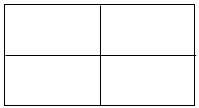
How many rectangles are there in the given figure?
- (a)9
- (b)6
- (c)8
- (d)4
Answer
Why
Correct — A. The figure is a single outer rectangle cut by one horizontal line and one vertical line, both running edge to edge, so it is a 2 by 2 grid of four cells.
Rule: a rectangle is fixed by choosing two vertical lines and two horizontal lines.
The figure has 3 verticals (left edge, middle, right edge) and 3 horizontals (top edge, middle, bottom edge).
Count = C(3,2) × C(3,2) = 3 × 3 = 9.
By hand it is 4 single cells + 2 rows + 2 columns + 1 whole figure = 9 → option (a).
Why the others are wrong
- (b)6 — 6 counts the four cells and the two rows, and stops there. The two columns and the outer rectangle are still rectangles.
- (c)8 — 8 is the full count with the outer rectangle left out: 4 cells + 2 rows + 2 columns. The boundary of the figure is a rectangle too.
- (d)4 — 4 counts only the four smallest cells and ignores every rectangle formed by joining two or four of them together.
Concept
Counting rectangles by eye fails on anything larger than this figure, so use the line-pair rule instead.
Any rectangle is decided by two of the vertical lines and two of the horizontal lines, which makes the total C(v,2) × C(h,2) where v and h count the full-length lines.
Here v = 3 and h = 3, so the answer is 3 × 3 = 9. The hand count agrees, and agreeing twice is the point of doing both.
The shortcut is only valid when every line runs the full width or full height of the figure, as all four do here. Where a line stops part-way, the formula over-counts and the rectangles must be listed by size instead.
Key facts
- In a full grid the rectangle count is C(v,2) × C(h,2), where v and h are the numbers of full vertical and horizontal lines.
- This figure has v = 3 and h = 3, giving C(3,2) × C(3,2) = 9.
- A 3 by 3 grid of cells, by the same rule, holds C(4,2) × C(4,2) = 36 rectangles.
Study next
Common traps
- Counting only the four smallest cells
- Forgetting that the outer boundary is itself one of the rectangles
- Applying the grid formula to a figure whose lines do not run edge to edge
The figure is small and the four options are close, so the count has to be systematic rather than visual. The counting-figures stem also appears on 09 Sep 2024, 12:30, Reasoning Q.1 and on 11 Sep 2024, 09:00, Reasoning Q.3, both asking for triangles.
Related PYQs
No directly related past PYQ was found.