
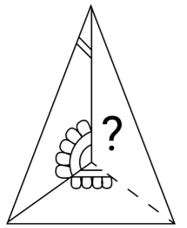
Select the option figure that will replace the question mark (?) in the figure given below to complete the pattern.
- (a)
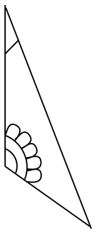
- (b)
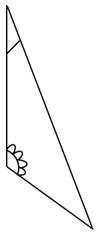
- (c)
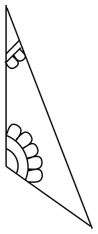
- (d)
Answer
Why
Correct — D. Rule: the figure is symmetric about the vertical line running down from the apex.
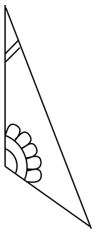
Three interior lines meet at one point inside the triangle: one going up to the apex, one down to the bottom-left corner, and one drawn dashed down to the bottom-right corner. That leaves a left wedge, a bottom wedge and an empty right wedge.
The left wedge carries two short parallel strokes near the apex and a fan of petals around a quarter-arc at the meeting point.
Mirror that wedge across the vertical line and you need both strokes plus the full fan, and nothing else. Option (d) supplies exactly that.
Why the others are wrong
- (a)Option (a) carries a single stroke near the apex. The left wedge shows two parallel strokes there, and a mirror image cannot lose one of them.
- (b)Option (b) shrinks the fan to a few small petals tucked into the corner, and it too shows one stroke at the apex. Both the size and the stroke count are wrong for a reflection.
- (c)Option (c) adds petals just below its double stroke near the apex. The left wedge has nothing in that position, and a mirror image may not invent an element.
Concept
This is a figure-completion item built on line symmetry, not on rotation. The mirror axis is the vertical line from the apex through the point where the interior lines meet.
Work it in two passes. First fix the outline: the missing piece must carry the vertical axis on one side and the triangle's own right edge on the other, which already rejects any option of the wrong shape.
Then compare element by element against the half you can see — how many strokes, how large the fan, and whether anything extra has crept in.
The bottom wedge carries its own motif, a row of rounded scallops along a line. It is not part of the missing piece and can be set aside once the axis is fixed.
Key facts
- A reflection preserves the count and the size of every element and reverses only left and right.
- The mirror axis here joins the apex to the point where the three interior lines meet.
- An option that adds an element the visible half does not have cannot be a mirror image, however close the rest looks.
Study next
Common traps
- Glancing at the apex and accepting an option that shows a single stroke.
- Choosing an option because its fan looks right and never checking the apex.
- Mirroring the bottom wedge's scallops into the missing piece.
Reflection is asked directly at Reasoning Q.24 of this shift, where a mirror is placed at line MN, and indirectly at Reasoning Q.6, where a punched sheet has to be unfolded across its creases.
Related PYQs
No directly related past PYQ was found.