
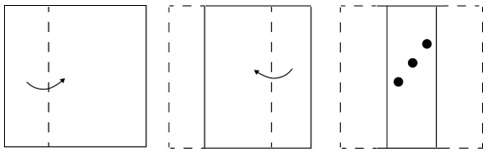
A square sheet of paper is folded along the dotted line successively along the directions shown and is then punched in the last as shown. How would the paper look when unfolded?
- (a)
- (b)
- (c)
- (d)
Answer
Why
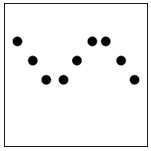
Correct — A. Rule: a fold reflects, so unfolding mirrors every hole about the crease you open.
The square is creased into three vertical strips. The left strip folds rightward onto the middle strip, then the right strip folds leftward onto it, leaving a three-layer strip in the centre.
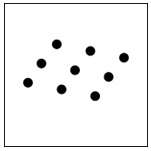
The punch passes through all three layers at low-left, middle and high-right, so the visible line of holes rises from left to right.
Unfolded, nine holes appear in three columns. The centre column still rises. The outer columns are its mirror images and therefore fall from left to right — option (a).
Why the others are wrong
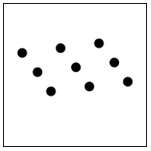
- (b)Option (b) repeats one falling diagonal in all three columns. A fold mirrors, so neighbouring columns must slope opposite ways — and the centre column, the layer you can see punched, rises.
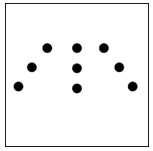
- (c)Option (c) stacks its three centre holes in a vertical line on the axis. The punched strip shows a diagonal there, so this contradicts the layer visible before any unfolding.
- (d)Option (d) slides the same rising diagonal across the sheet, dropping it a step each time. Folding reflects about a crease, it does not translate, so the columns cannot drift downward.
Concept
Fold-and-punch is a reflection problem. Two facts settle every one of them.
First, the number of holes is the number of punches multiplied by the number of layers, provided the punch clears the whole stack. Three punches through three layers give nine holes.
Second, each unfold is a mirror about the crease being opened, not a copy shifted sideways. A diagonal that rises in one panel must fall in the panel beside it, and the finished pattern is symmetric about every crease.
Only the top layer's own punches are visible in the stem figure. Everything to the left and right of the strip has to be reconstructed, so matching the visible column against each option first is the fastest filter.
Key facts
- Holes equal punches multiplied by layers, when the punch passes through the whole stack.
- Unfolding a crease reflects the holes across it, so each hole's distance from the crease is preserved.
- Two folds inward onto the same central strip leave three layers, not four.
Study next
Common traps
- Copying the punched pattern into each panel instead of mirroring it.
- Assuming two folds always give four layers, which holds only when each fold halves the stack.
- Reading an arrow backwards and mirroring about the wrong crease.
Fold-and-punch items appear at 09 Sep 2024, 12:30, Reasoning Q.20 and at 18 Sep 2024, 09:00, Reasoning Q.4. Reasoning Q.24 of this shift asks for a mirror image about a line MN, which is the same reflection idea without the folding.
Related PYQs
No directly related past PYQ was found.