
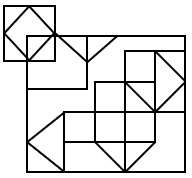
How many squares are there in the given figure?
- (a)14
- (b)12
- (c)11
- (d)15
Answer
Why
Correct — D. Count by group, largest first, and take every box closed on all four sides.
The whole outline is one square. The large square in the top-left of the main body — left and top edges of the figure, closed by the vertical and the horizontal that each stop half way — is a second. That is 2.
The block jutting out at the top-left adds three: its own outline, the tilted square joining the midpoints of its sides, and the small square where it overlaps the main figure. That is 3.
The grid filling the right and lower part gives 6 single cells and 4 double squares, each two grid steps to a side.
2 + 3 + 6 + 4 = 15 → option (d).
Why the others are wrong
- (a)14 — 14 is one short of the tally. Check the outer boundary — the figure's own outline is a square and counts alongside the small cells inside it.
- (b)12 — 12 is what you get by refusing the three shapes the printing makes a shade wider than tall: the outer boundary, the big square in the top-left of the main body, and the small square where the jutting block overlaps it. All three are meant as squares.
- (c)11 — 11 leaves out the tilted square as well. A square standing on its corner counts exactly like an upright one.
Concept
Counting figures is bookkeeping, not looking. Fix an order — largest first, or smallest first — and never let your eye wander back over ground you have covered.
The reliable method is to work by size class: single grid cells, then blocks two cells to a side, then the outlines that enclose everything, then any square set at 45 degrees. Each class is finite, and you can say out loud when it is finished.
Three of the fifteen are printed a shade wider than tall on the scanned paper. They are meant as squares, and a candidate who insists on perfect proportions will land on a lower count.
Key facts
- A tilted square counts as a square, so a diamond joining the midpoints of a square's sides adds one to the tally.
- Work by size class and finish each class before starting the next.
- The overlap of two shapes can itself be a square, as it is where the top-left block crosses the main figure.
Study next
Common traps
- Counting only upright squares and missing the tilted one
- Forgetting the outer boundary of the whole figure
- Counting a shape whose fourth side is not actually drawn
The same one-line stem returns with a different figure at 10 Sep 2024, 09:00, Reasoning Q.14 and at 12 Sep 2024, 12:30, Reasoning Q.10. The triangle-counting version is set the same way at 09 Sep 2024, 09:00, Reasoning Q.19, and rewards the same size-class bookkeeping.
Related PYQs
No directly related past PYQ was found.