
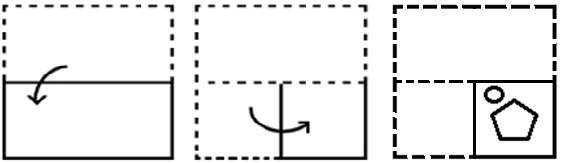
The sequence of folding a piece of paper and the manner in which the folded paper has been cut is shown in the following figures. How would this paper look when unfolded?
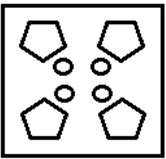
- (a)
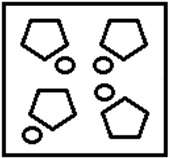
- (b)
- (c)
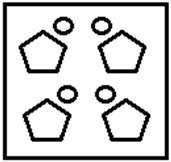
- (d)
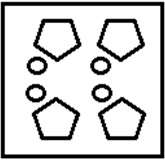
Answer
Why
Correct — A. Rule: unfold in reverse order, mirroring across each fold line; a cut keeps its distance from the fold it was made near.
Fold 1: the top half of the square is folded down onto the bottom half, leaving a half-height rectangle.
Fold 2: the left half of that rectangle is folded across to the right, leaving a quarter-size square — the sheet's bottom-right quadrant.
Two holes are cut in that packet: a small circle near its top-left corner and a pentagon at its middle. The packet's top edge is the first fold line and its left edge is the second.
Opening the vertical fold mirrors both shapes into the bottom-left quadrant. Opening the horizontal fold mirrors all four into the top half. Two cuts become eight — four circles and four pentagons.
The circle was cut close to both folds, so its four copies cluster around the centre. The pentagon was cut further out, so its four copies spread to the corners. That is option (a).
Why the others are wrong
- (b)Its bottom-left group breaks the pattern: the circle sits below-left of its pentagon, out at the sheet's corner. Every unfolded copy must be a mirror, so that circle belongs above-right of its pentagon, near the centre like the other three.
- (c)It places the circle above its pentagon in the top half and above it again in the bottom half. A horizontal fold demands a reflection between the halves, so the top half must carry its circles below the pentagons.
- (d)It copies the right half onto the left rather than mirroring it — the left-hand circles sit to the left of their pentagons, exactly as the right-hand ones do. A vertical fold reverses left and right.
Concept
Unfolding is folding run backwards. The last fold made is the first one opened, and each opening reflects everything already on the paper across that fold line.
Two folds therefore turn every cut into four copies, so two cuts open into eight shapes. Counting the shapes is often enough to eliminate an option before you look at where they sit.
The useful invariant is distance. A hole cut near a fold line opens into copies that stay near that line; one cut far from it opens into copies that spread out. That places the shapes without redrawing the sheet.
The third panel shows the folded packet with its cuts, not the whole sheet — read it as the quarter it is, and identify which of its edges are folds before mirroring anything.
Key facts
- Each fold doubles the number of cut shapes, so two cuts through two folds open into eight.
- The packet here is the sheet's bottom-right quadrant, so its top edge and left edge are the two fold lines.
- The circle is cut close to both fold lines, so its four copies finish clustered around the centre.
- The pentagon is cut further from both folds, so its four copies finish at the four corners.
Study next
Common traps
- Counting the shapes correctly but accepting an option whose halves are translated instead of reflected
- Unfolding in the order the folds were made rather than reversing it
- Mistaking the packet's outer edges for the fold lines
Another folded-and-cut item is set at Reasoning Q.11, 19 Sep 2024, 16:00. Both are decided the same way: reverse the folds one at a time and check each half of an option against the half it is supposed to mirror.
Related PYQs
No directly related past PYQ was found.