
How many triangles are there in the given figure?
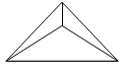
- (a)5
- (b)4
- (c)2
- (d)3
Answer
Why
Correct — B. Rule: list the segments the figure is drawn from, then count the triples of them that close.
The figure is a large triangle with apex A on top and base corners L and R. A short vertical drops from A to an interior point M, and from M two lines run down to L and to R.
That is six segments: AL, AR, LR, LM, MR and AM. Four triples of them close:
A–L–M, from AL, LM and AM
A–M–R, from AM, MR and AR
L–M–R, the shallow triangle sitting on the base
A–L–R, the whole outer triangle
So there are four triangles, which is option (b). No other triple closes, because the two inner lines meet the slanted sides only at the corners L and R.
Why the others are wrong
- (a)5 — 5 over-counts, most often by treating A–L–M–R as a triangle. That region is bounded by AL, LM, MR and AR — four sides, not three, and it dips inward at M.
- (c)2 — 2 counts only the two upper halves, A–L–M and A–M–R. It misses the inner triangle L–M–R and the outer triangle A–L–R entirely.
- (d)3 — 3 counts the figure's three separate regions and stops there, forgetting that the base and the two full slanted sides still close the outer triangle A–L–R.
Concept
Counting figures rewards a method over a stare. Write down the segments the figure is built from, then ask which triples of them close.
A triangle needs three segments meeting pairwise at three different points. Three segments through one common point close nothing, and two segments that never meet close nothing either.
The count includes both the figure's own regions and any larger shape formed by combining them — including the outline itself, which is easy to overlook once the interior lines take your attention.
The figure is drawn small and the inner lines run close to the outer sides near the base. They meet those sides only at L and at R, so no extra intersection points exist to generate further triangles.
Key facts
- The figure is drawn from six segments: AL, AR, LR, LM, MR and AM.
- Three of the four triangles are the figure's own regions, namely A–L–M, A–M–R and L–M–R.
- The fourth is the outline A–L–R, which no interior line divides away.
- The region A–L–M–R has four sides and must not be counted.
Study next
Common traps
- Forgetting the outer triangle because the interior lines pull the eye inward
- Counting the concave quadrilateral A–L–M–R as a triangle
- Assuming the inner lines cut the slanted sides, when they touch them only at the base corners
The figure is deliberately small and the count is low, so the item separates candidates on completeness rather than on effort. Listing the segments takes about as long as staring at it and does not leave the outline out.
Related PYQs
No directly related past PYQ was found.