
If A is an acute angle, then √[(1 − cosA) ⁄ (1 + cosA)] + √[(1 + cosA) ⁄ (1 − cosA)] is equal to:

- (a)
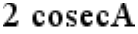
- (b)
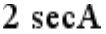
- (c)
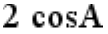
- (d)
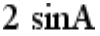
Answer
Why
Correct — A. The two surds are reciprocals of each other, so put them over one common denominator instead of evaluating either.
Let S = √((1 − cosA)⁄(1 + cosA)) + √((1 + cosA)⁄(1 − cosA))
Common denominator = √((1 + cosA)(1 − cosA)) = √(1 − cos²A) = sinA
Numerator = (1 − cosA) + (1 + cosA) = 2
S = 2 ⁄ sinA = 2 cosecA → option (a), the picture reading 2 cosecA
Why the others are wrong
- (b)2 secA is 2 ⁄ cosA. It comes from taking the common denominator as cosA, but (1 + cosA)(1 − cosA) is 1 − cos²A = sin²A, so sinA is what sits underneath.
- (c)2 cosA multiplies by cosA where the working divides by sinA. It is also below 2 for every acute A, and a positive number plus its reciprocal is never less than 2.
- (d)2 sinA puts sinA in the numerator, inverting the last step of S = 2 ⁄ sinA. Like 2 cosA it stays under 2, which the sum of two reciprocal surds cannot do.
Concept
Anything of the form √((1 − cosA)⁄(1 + cosA)) is cleared by the difference of squares: multiply the two conjugates and (1 + cosA)(1 − cosA) = sin²A.
Because the second surd is the first one upside down, you never have to simplify either separately. Adding p and 1⁄p over a common denominator collapses the numerator to (1 − cosA) + (1 + cosA) = 2.
A second route reaches the same place: each surd is a half-angle form, tan(A⁄2) and cot(A⁄2), and tanθ + cotθ = 1 ⁄ (sinθ cosθ) = 2 ⁄ sinA when θ = A⁄2.
The wording A is an acute angle is doing real work: it makes sinA positive, so √(sin²A) is sinA and not −sinA, and it also rules out A = 0°, where 1 − cosA would be 0 and the second surd undefined.
Key facts
- (1 + cosA)(1 − cosA) = 1 − cos²A = sin²A.
- cosecA means 1 ⁄ sinA, so 2 ⁄ sinA is written 2 cosecA.
- For an acute A, sinA > 0, so √(sin²A) = sinA with no sign ambiguity.
- For any positive p, p + 1⁄p is at least 2, which is why the answer cannot be 2 sinA or 2 cosA.
Study next
Common traps
- Adding the two surds as if √p + √q equalled √(p + q).
- Hesitating over ±sinA when the word acute already fixes the sign as positive.
- Rationalising only one surd and losing the symmetry that collapses the numerator to 2.
One expression to simplify, four one-term options: the same build is set at 25 Sep 2024, 09:00, Quant Q.1, which asks for the value of (cosec θ − sin θ)(sec θ − cos θ)(tan θ + cot θ).
A related manipulation, secθ + tanθ = x solved for sinθ, is asked at 25 Sep 2024, 16:00, Quant Q.14.
Related PYQs
No directly related past PYQ was found.