
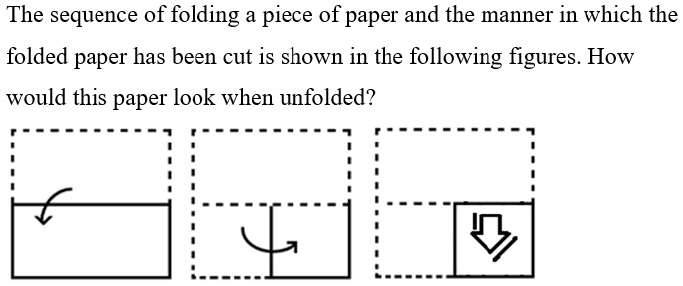
The sequence of folding a piece of paper and the manner in which the folded paper has been cut is shown in the following figures. How would this paper look when unfolded?
- (a)
- (b)
- (c)
- (d)
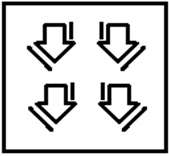
Answer
Why
Correct — A.
Rule: each unfold mirrors the cut across the crease being opened — it never rotates the cut and never simply repeats it.
The top half folds down, then the left half folds right, leaving a quarter-size square at the bottom right. The cut there is a downward arrow with a nick at its upper left and a slash at its lower right.
Open the vertical crease: the bottom-left quarter is its left-right mirror — arrow still down, nick upper right, slash lower left.
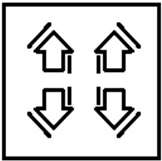
Open the horizontal crease: the bottom half flips upward, so both top quarters carry arrows pointing up, each mirroring the quarter below it.
Two down arrows below, two up above: option (a).
Why the others are wrong
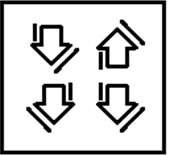
- (b)Option (b) mirrors correctly except in its top-left quarter, where the arrow still points down. Opening the horizontal fold flips both upper quarters, so both must point up.
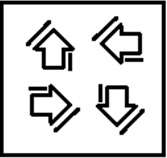
- (c)Option (c) rotates the cut — its four arrows point up, left, right and down. Unfolding reflects across a crease, so a turned copy can never appear.
- (d)Option (d) mirrors left to right correctly but never flips top to bottom — all four arrows still point down. Opening the horizontal crease has to turn the upper pair upward, as option (a) does.
Concept
Paper folding is one rule applied backwards: unfolding is reflection. Undo the folds in reverse order, and at each step the part you open is the mirror image of what is already drawn, taken across the crease you just opened.
Two folds therefore mean two reflections and four copies of the cut, arranged as two mirror pairs. Nothing rotates and nothing slides.
The cut here is asymmetric — an arrow with a nick on one side and a slash on the other — so every reflection shows, which is what makes the four options separable at a glance.
This row carries no question text of its own. The wording sits inside the question image, above the three fold panels.
It reads: the sequence of folding a piece of paper and the manner in which the folded paper has been cut is shown in the following figures, and how would this paper look when unfolded. The picture is the whole instruction.
Key facts
- Unfolding reflects the cut across the crease being opened, taking the folds in reverse order.
- Each fold that halves the sheet doubles the copies, so two folds give four copies of a cut lying wholly inside the folded region.
- The second fold here is vertical, so the first unfold produces a left-right mirror pair across the bottom half.
Study next
Common traps
- Rotating the cut instead of reflecting it, which is what option (c) offers
- Unfolding in the order the folds were made rather than in reverse order
A folding-and-cutting item in the same frame is also set at 19 Sep 2024, 16:00, Reasoning Q.23. A character-position series is also set at 19 Sep 2024, 12:30, Reasoning Q.3.
Related PYQs
No directly related past PYQ was found.