
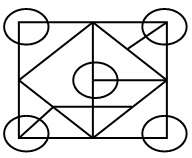
How many triangles are there in the given figure?
- (a)13
- (b)14
- (c)15
- (d)16
Answer
Why
Correct — C. Label the figure first. The rectangle is A (top-left), B (top-right), C (bottom-right), D (bottom-left). The rhombus joins the four side midpoints T (top), R (right), M (bottom), L (left), and the vertical TM passes through the centre O.
Rule: count the four regions outside the rhombus, then the regions inside it.
Outside: A-T-L, T-B-R, R-C-M, L-D-M = 4
The short line from B to a point S on TR splits T-B-R in two = +2
The short line from D to a point P on LM splits L-D-M in two = +2
Inside, the vertical TM gives T-L-M and T-R-M = +2
The half-diagonal O-R splits T-R-M into T-O-R and O-M-R = +2
The lower horizontal P-Q meets TM at W and gives P-M-W, W-M-Q and P-M-Q = +3
4 + 2 + 2 + 2 + 2 + 3 = 15 -> option (c). The five ellipses form no triangles.
Why the others are wrong
- (a)13 — 13 is the count when the half-diagonal O-R is overlooked, losing T-O-R and O-M-R. It is easy to miss because that horizontal starts at the centre and never reaches L.
- (b)14 — 14 is the count when P-M-Q is missed — the triangle that spans the vertical and is made of P-M-W and W-M-Q joined. Composite triangles are counted last and forgotten first.
- (d)16 — 16 is one triangle more than the figure holds. The tempting extra is L-T-R, the top half of the rhombus — but that needs a horizontal running the full width from L to R, and only the half from the centre O to R is drawn.
Concept
Counting triangles is bookkeeping, not a staring contest. Label every named point before you count: the four rectangle corners, the four midpoints the rhombus joins, the centre, and the points where the extra segments land.
Then count in groups. Take the four regions outside the rhombus first, then the inside.
Remember that a line from a vertex to the opposite side turns one triangle into three — the original plus its two halves. The group people miss is the last one: a triangle made of two smaller ones joined along a shared line.
Four ellipses sit over the rectangle's corners and one sits at the centre. They are decoration — a triangle needs three straight sides, so no ellipse can contribute to the count.
Key facts
- The horizontal diagonal of the rhombus is drawn only from the centre to the right vertex, not across the full width.
- A cevian from a vertex to the opposite side turns one triangle into three.
- The figure has five segments beyond the rectangle and the rhombus: the vertical, two horizontals and two short corner diagonals.
- Seven of the fifteen triangles lie inside the rhombus and eight lie outside it.
Study next
Common traps
- Treating the ellipses as if a curved line could close a triangle.
- Missing P-M-Q, the triangle built from the two smaller ones either side of the vertical.
- Assuming the horizontal diagonal runs the full width of the rhombus, which would add four triangles and take the count to 19.
The figure here is a rectangle with an inscribed rhombus and five extra segments, which is enough structure that a labelled sketch beats eyeballing every time.
This shift asks you to read a figure again at Reasoning Q.5 (19 Sep 2024, 09:00), there as a mirror image rather than a count.
Related PYQs
No directly related past PYQ was found.