
Identify the figure from among the given options which when put in place of the question mark (?) will logically complete the series.
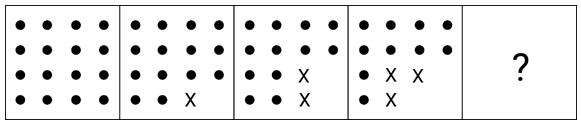
- (a)
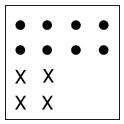
- (b)
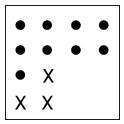
- (c)
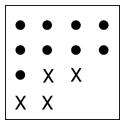
- (d)
Answer
Why
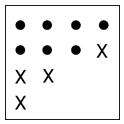
Correct — A. Each box is a grid of dots and crosses, so count the two mark types.
Rule: every step removes two dots and adds one cross.
Box 1: 16 dots, 0 crosses
Box 2: 14 dots, 1 cross
Box 3: 12 dots, 2 crosses
Box 4: 10 dots, 3 crosses
The fifth box must therefore hold 8 dots and 4 crosses. Option (a) shows two full rows of four dots on top and a block of four crosses below — 8 and 4.
Why the others are wrong
- (b)Option (b) leaves a dot standing at the start of the third row, so it has 9 dots and only 3 crosses. The dots must fall to 8 and the crosses must reach 4.
- (c)Option (c) has the required 4 crosses but 9 dots, because a dot survives at the start of the third row. Nine breaks the fall of two from box 4's ten.
- (d)Option (d) breaks the grid higher up: a cross replaces the last mark of the second row, leaving 7 dots. In every box of this series the top two rows are four dots wide.
Concept
Not every picture series is about rotation. When a frame is a grid of identical marks, it is worth counting before you look for a turn.
Write two numbers under each box — the dot count and the cross count. Here dots fall by two and crosses rise by one at every step, so the total number of marks drops by one each time.
Once the target pair is fixed at 8 and 4, the options can be checked in seconds without deciding where anything ought to sit.
Marks are lost from the lower rows while the top two rows stay four dots wide in every box of the series, so the arrangement will not separate the options. The counts will.
Key facts
- Dots run 16, 14, 12, 10, 8 across the five boxes.
- Crosses run 0, 1, 2, 3, 4 across the same five boxes.
- Total marks in a box fall by one each step, from 16 down to 12.
Study next
Common traps
- Counting the crosses alone, which option (c) also satisfies with four.
- Assuming the marks must keep a neat rectangular block and choosing on shape.
- Missing that a dot has gone from a row that still looks full.
SSC's picture series are often arithmetic in disguise, and a dot-and-cross grid is the clearest case: count first.
This shift also runs a corner-mark figure series at Reasoning Q.6 (19 Sep 2024, 09:00), where counting gets you nowhere and orientation decides it.
Related PYQs
No directly related past PYQ was found.