
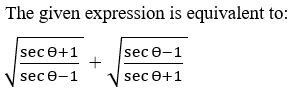
The given expression is equivalent to: √((sec θ + 1) ⁄ (sec θ − 1)) + √((sec θ − 1) ⁄ (sec θ + 1))
- (a)

- (b)
- (c)

- (d)

Answer
Why
Correct — A. Put both surds over the single denominator √((sec θ + 1)(sec θ − 1)):
= [(sec θ + 1) + (sec θ − 1)] ⁄ √(sec²θ − 1)
= 2 sec θ ⁄ √(sec²θ − 1)
sec²θ − 1 = tan²θ, so the denominator is tan θ:
= 2 sec θ ⁄ tan θ
Now write both ratios in sine and cosine:
= 2 × (1 ⁄ cos θ) × (cos θ ⁄ sin θ)
= 2 ⁄ sin θ = 2 cosec θ → option (a).
Why the others are wrong
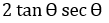
- (b)2 tan θ sec θ multiplies by tan θ where the working divides by it. tan θ arrives as the denominator √(sec²θ − 1), so it sits under the 2 sec θ.
- (c)2 sin θ confuses cosec with sin. The simplification ends at 2 ⁄ sin θ, and 2 ⁄ sin θ is 2 cosec θ, the reciprocal ratio, not sin θ doubled.
- (d)2 tan θ keeps the tan θ from √(sec²θ − 1) and throws away the 2 sec θ above it. The numerator does not cancel — it is divided by tan θ.
Concept
Two square roots that are reciprocals of each other always add the same way: √(A⁄B) + √(B⁄A) = (A + B) ⁄ √(AB). One move clears both radicals, which is faster than rationalising the two terms separately.
Here A = sec θ + 1 and B = sec θ − 1, so A + B = 2 sec θ and AB = sec²θ − 1 = tan²θ. The difference of squares in the denominator is the whole reason the pair was chosen.
The three Pythagorean identities behind this family are sin²θ + cos²θ = 1, 1 + tan²θ = sec²θ and 1 + cot²θ = cosec²θ.
Every option is a ratio of the same angle, so an answer left as 2 sec θ ⁄ tan θ matches nothing. Carrying the expression down to sine and cosine is what makes it recognisable.
Key facts
- sec²θ − 1 = tan²θ, the rearranged form of 1 + tan²θ = sec²θ.
- √(A⁄B) + √(B⁄A) = (A + B) ⁄ √(AB).
- sec θ ÷ tan θ = 1 ⁄ sin θ = cosec θ.
Study next
Common traps
- Rationalising each surd on its own and losing a sign in the second term.
- Writing sec²θ − 1 as cot²θ by picking the wrong Pythagorean identity.
- Stopping at 2 sec θ ⁄ tan θ and choosing whichever option contains tan θ.
SSC sets identity questions as a one-line simplification whose four options are different ratios of the same angle, so the marks go to whoever converts fastest.
Trigonometry is also set at Quant Q.5 of this shift, where sin A sin B has to be matched to an identity, and at Quant Q.22, where complementary angles collapse sin²26° + sin²64° to 1. The same simplify-the-product task is asked on 25 Sep 2024, 09:00, Quant Q.1.
Related PYQs
No directly related past PYQ was found.