
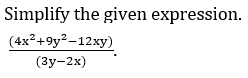
Simplify the given expression. (4x² + 9y² − 12xy) ⁄ (3y − 2x).
- (a)

- (b)

- (c)

- (d)

Answer
Why
Correct — A. The numerator is a perfect square once you reorder it as 9y² − 12xy + 4x².
9y² − 12xy + 4x² = (3y)² − 2(3y)(2x) + (2x)²
= (3y − 2x)²
(3y − 2x)² ⁄ (3y − 2x) = 3y − 2x → option (a).
A square is sign-blind, so (2x − 3y)² is the same numerator. What decides the sign of the surviving factor is the denominator the paper prints, 3y − 2x.
Why the others are wrong
- (b)2y − 3x puts the coefficients on the wrong letters. √(9y²) is 3y and √(4x²) is 2x, so the factor is built from 3y and 2x.
- (c)3x − 2y would need 9x² and 4y² in the numerator. The paper prints 4x² and 9y², which is the other way round.
- (d)2x − 3y is the negative of the answer. Its square is the same numerator, but dividing that square by the printed denominator 3y − 2x leaves 3y − 2x.
Concept
A quadratic in two letters is a perfect square when the middle term is exactly twice the product of the two square roots.
Here √(9y²) = 3y and √(4x²) = 2x, and 2 × 3y × 2x = 12xy, which is the middle term printed. The middle term is negative, so the bracket carries a minus.
Then the cancellation is trivial: any square divided by its own base leaves the base. The only judgement left is which of the two equal squares, (3y − 2x)² or (2x − 3y)², matches the denominator you are dividing by.
The paper writes the numerator as 4x² + 9y² − 12xy — out of order, with the middle term last. Reordering before you judge is the whole trick.
Key facts
- a² − 2ab + b² = (a − b)², and the middle term must be twice the product of the square roots.
- 4x² + 9y² − 12xy factors as (3y − 2x)², which equals (2x − 3y)².
- (3y − 2x)² divided by (3y − 2x) is 3y − 2x.
Study next
Common traps
- Cancelling to 2x − 3y after factoring as (2x − 3y)² and ignoring which factor the denominator is.
- Calling 4x² + 9y² − 12xy unfactorable because the terms are not in descending order.
SSC prints the trinomial out of order so the square is not obvious, then offers all four sign-and-letter permutations as options.
Identity work is also set at Quant Q.10 of this shift, where 27a³ + 8b³ has to be read as (3a)³ + (2b)³.
Related PYQs
No directly related past PYQ was found.