
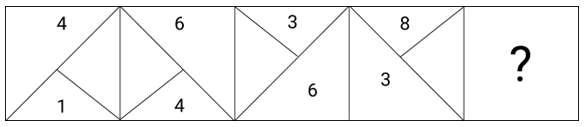
Identify the figure given in the options which when put in place of ? will logically complete the series.
- (a)
- (b)
- (c)
- (d)
Answer
Why
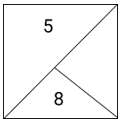
Correct — B. Two patterns run together, one on the lines and one on the numbers.
Rule: each square is the one before it turned 90° clockwise.
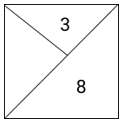
Square 1 has a diagonal rising from bottom-left to top-right, with a spur from that diagonal's midpoint to the bottom-right corner. Each quarter-turn gives the next square, and four turns close the circle — so square 5 repeats square 1's layout.
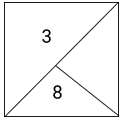
Option (d) draws square 3's instead, spur to the top-left, so it goes on the lines alone.
Rule: each square's lower number is the upper number of the square before it, running 4, 6, 3. Square 5 carries 8 below, which removes option (a) and its 2.
That leaves (b) and (c), and only the number above the 8 separates them. In the rising-diagonal squares the pair has added to 5, then 9, and option (b)'s 5 is the one that keeps that run going.
Why the others are wrong
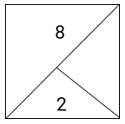
- (a)Option (a) draws the right layout but puts 2 below. The lower number is handed down by the square before, and square 4 carries 8 upstairs, so 8 is what has to appear.
- (c)Option (c) puts 3 above the 8. That pair adds to 11 and does not continue the 5, then 9 of the earlier rising-diagonal squares — the only test left once the lines and the carried 8 are settled.
- (d)Option (d) fails on the figure before its numbers matter. Its spur runs from the diagonal's midpoint to the top-left corner, which is square 3's layout, whereas four clockwise turns put square 5 back on square 1's.
Concept
A number-in-figure series carries two independent patterns and both have to be read. The lines usually rotate or reflect on a fixed step, and the numbers usually run as an arithmetic series threaded through the figures.
Settle the lines first. It is the cheaper test and it often kills options outright — here the quarter-turn rule fixes square 5's layout exactly and eliminates one option before any arithmetic starts.
Then read the numbers in a fixed order, upper first and lower second, and look for a value that repeats across the boundary between two figures. A number that reappears is a chain, and a chain hands you one of the two missing values for free.
The quarter-turn and the carried 8 are the firm tests, and between them they leave only options (b) and (c) standing.
The step that separates those two is weaker, and worth seeing for what it is: two observed sums, 5 and then 9, with the answer as the third point. The even-numbered squares add to 10 and 11, so this is a run read down the rising-diagonal squares, not a rule the whole series obeys.
Key facts
- Each square is the previous one rotated 90° clockwise, so the layout repeats every fourth square.
- The lower number of each square is the upper number of the square before it, running 4, 6, 3, 8.
- In the 1st and 3rd squares — the ones with the rising diagonal — the two numbers add to 5 and to 9.
- Square 5 therefore repeats square 1's lines and carries the keyed 5 above the 8.
Study next
Common traps
- Choosing on the numbers alone and missing that one option draws the wrong spur.
- Turning the figure anticlockwise, which lands square 5 on square 3's layout.
- Reading the two numbers in a different order in different squares, which breaks the chain.
The identical stem — identify the figure given in the options which when put in place of ? will logically complete the series — also runs at 10 Sep 2024, 12:30, Reasoning Q.11 and at 11 Sep 2024, 09:00, Reasoning Q.5, over different figures.
Related PYQs
No directly related past PYQ was found.