
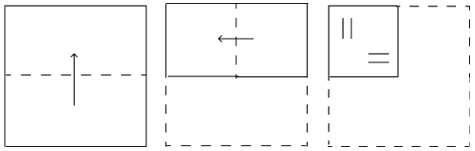
A paper is folded and cut as shown below. How will it appear when unfolded?
- (a)
- (b)
- (c)
- (d)
Answer
Why
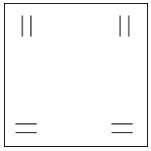
Correct — C. Rule: undo the folds in reverse order, mirroring every cut across each crease as you go.
The sheet is folded bottom half up, then right half left. What survives is a quarter occupying the top-left corner of the original square.
Two cuts sit on that quarter: a pair of short vertical slits near its outer corner, and a pair of short horizontal slits close to where the two creases meet.
Undo the left-right fold and both marks mirror across the vertical centre line. Undo the bottom-up fold and everything mirrors across the horizontal centre line. Each cut therefore ends up four times over.
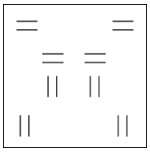
The vertical pairs, cut far from both creases, land at the four corners of the sheet. The horizontal pairs, cut close to the creases, gather around the centre. That is option (c).
Why the others are wrong
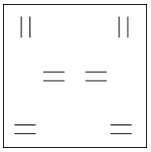
- (a)Option (a) drops half the copies. Its vertical pairs sit at the top two corners only, when undoing the bottom-up fold has to reproduce them at the bottom two corners as well.
- (b)Option (b) puts the horizontal pairs at the top corners and the vertical pairs at the bottom corners. A mirror cannot turn one cut into the other, so a vertical slit stays vertical wherever it lands.
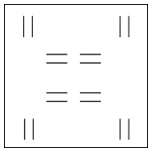
- (d)Option (d) shows four groups of marks where two folds must yield four copies of each of the two cuts, that is eight groups. The whole inner cluster is missing.
Concept
A paper-folding item is worked backwards. Undoing a fold reflects everything on the folded sheet across that fold's crease, so one cut on a sheet folded twice opens out into 2² = four cuts.
Position matters as much as count. A cut near the outer corner of the folded quarter, far from both creases, opens out to the four outer corners of the sheet. A cut near where the creases meet opens out into a tight cluster around the centre.
So before comparing options, settle two things about each mark on the folded figure: how far it lies from each crease, and which way it is oriented. Both survive every fold you undo.
Orientation survives the mirrors here because the slits run parallel or perpendicular to the creases. A vertical slit reflected in a vertical or a horizontal line is still vertical.
Key facts
- The sheet is folded twice, so each cut opens out into four copies.
- The vertical pair is cut near the outer corner of the folded quarter, so its copies land at the four corners of the sheet.
- The horizontal pair is cut near the two creases, so its copies cluster around the centre.
- The unfolded sheet is symmetric about both the vertical and the horizontal centre line.
Study next
Common traps
- Getting the count right but placing the copies by eye, so an outer-corner cut drifts towards the centre.
- Forgetting that the last fold made is the first fold undone.
- Reading the dashed outline in the figure as part of the paper rather than as the folded-away portion.
SSC prints the stem word for word and varies only the folds and the cut. 18 Sep 2024, 12:30, Reasoning Q.11 asks it earlier in the Reasoning run, and 17 Sep 2024, 12:30, Reasoning Q.4 and 11 Sep 2024, 09:00, Reasoning Q.15 and Q.18 all carry the same sentence.
Related PYQs
No directly related past PYQ was found.