
Identify the figure given in the options which when put in place of ? will logically complete the series.
- (a)
- (b)
- (c)
- (d)
Answer
Why
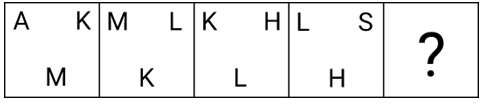
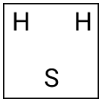
Correct — C. Each cell carries three letters: one at the top left, one at the top right, one at the bottom.
Rule: every cell hands two letters on. Its bottom letter becomes the next cell's top-left letter, and its top-right letter becomes the next cell's bottom letter.
Cell 1 (A, K, M) → cell 2 (M, L, K): M moves bottom to top-left, K moves top-right to bottom.
Cell 3 (K, H, L) → cell 4 (L, S, H): L moves bottom to top-left, H moves top-right to bottom.
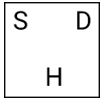
Cell 4 is (L, S, H), so cell 5 must carry H at the top left and S at the bottom. That removes option (b), which has S above and H below.
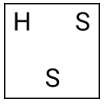
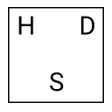
Every cell so far shows three different letters. Option (a) prints S twice and option (d) prints H twice, so both break that.
What survives — H at the top left, S at the bottom and a letter not yet used at the top right — is (H, D, S), option (c).
Why the others are wrong
- (a)Option (a) carries the two letters across correctly but then prints S in two places at once, top right and bottom. No cell in the given series shows a letter twice.
- (b)Option (b) has the carry the wrong way round. S was cell 4's top-right letter, so it belongs at the bottom, and H was its bottom letter, so it belongs at the top left.
- (d)Option (d) repeats H, at top left and top right. The top-left slot is already filled by the carry from cell 4, so the top-right letter has to be one not seen before.
Concept
This is a letter series dressed up as a figure. The four given cells are read left to right, and each shares two of its three letters with the next, so the reliable move is to trace where each letter travels rather than to hunt for alphabet arithmetic.
Trace K and the route shows itself: top right of cell 1, bottom of cell 2, top left of cell 3. L and H repeat it exactly, one cell later each time.
A and M head the chain with no earlier cell to have come from, and S, reaching cell 4's top right, has only cell 5 left to travel.
The series does not display a rule that fixes the new letter. D cannot be derived from A, M, K, L, H, S by any pattern the four given cells show, so it is reached by elimination: the carry fixes two of the three slots, and the no-repeat habit of the given cells removes the two options that duplicate a letter.
Key facts
- The bottom letter of one cell becomes the top-left letter of the next.
- The top-right letter of one cell becomes the bottom letter of the next.
- Across cells 1 to 4 no letter is repeated inside a cell — A K M, then M L K, then K H L, then L S H.
Study next
Common traps
- Looking for an alphabet gap between the three letters of a cell when the rule is purely positional.
- Stopping once the carry has fixed H and S, since three options still survive at that point.
- Assuming the new letter must be derivable, and settling for a repeat because no derivation shows itself.
SSC prints the letters at fixed places inside each cell and expects the positional carry to be seen before any alphabet arithmetic is tried. The same 'complete the series' instruction heads the figure item at Reasoning Q.14 of this shift.
Related PYQs
No directly related past PYQ was found.