
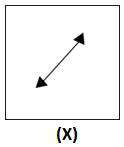
Select the option figure in which the given figure (X) is embedded (rotation is NOT allowed).
- (a)
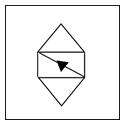
- (b)
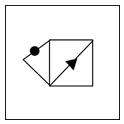
- (c)
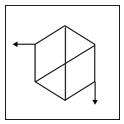
- (d)
Answer
Why
Correct — D. Figure (X) is one straight line running from lower left to upper right, with a solid arrowhead at both ends. That is the whole of it — no box, no second line.
Rule: rotation is not allowed, so the match must keep the same slant, and both arrowheads must be there, pointing outwards.
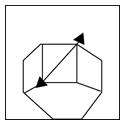
Option (d) shows an octagon with a square drawn inside it. The square's diagonal runs from its lower-left corner to its upper-right corner, at exactly the slant of (X).
That diagonal carries a solid arrowhead at its upper-right end and a second solid arrowhead at its lower-left end.
So the double-headed arrow sits inside the figure complete and unrotated — option (d).
Why the others are wrong
- (a)Option (a)'s line slants down to the right, from its inner rectangle's top-left corner to the bottom-right. (X) rises to the right, and rotation is barred. Its one arrowhead points down-and-right as well.
- (b)Option (b) has the right diagonal, corner to corner across its square, but only one arrowhead, set partway along the line and pointing up to the right. Its lower-left end is a plain corner, so (X)'s second head is missing.
- (c)The diagonal in option (c) is bare — no arrowhead at either end. Its two arrows are separate strokes outside the hexagon, one pointing left and one pointing down.
Concept
An embedded-figure item asks whether the whole of (X) can be traced inside the option — every line and every terminal mark, at the same orientation. When rotation is barred, the slant of each line is a hard test you can apply before looking at anything else.
Terminal marks count as much as lines. An arrowhead, a dot and a bare end are three different things, and this is where the near-miss options are built to differ. Extra lines in an option are never a problem, because (X) only has to be present, not alone.
Options (b), (c) and (d) each carry a line at the slant of (X), and what separates those three is entirely what sits at the ends of it.
Option (a) fails a step earlier: its line slants the other way, so the ends never come into it.
Key facts
- Figure (X) is a single straight line with a solid arrowhead at each end, slanting from lower left to upper right.
- The instruction bars rotation, so any match has to keep (X) at the same slant.
- In option (d) the required arrow is the diagonal of the square drawn inside the octagon.
Study next
Common traps
- Matching the line and forgetting the arrowheads, which is what makes option (b) tempting.
- Mentally rotating an option to make its diagonal fit, when the instruction bars rotation.
- Accepting option (b) on a single arrowhead, without checking that the far end of its diagonal carries one too.
SSC prints (X) as a very plain stroke and hides it inside a busier figure, with the near misses differing only at the ends of the line. The same patience with a figure decides the triangle count at Reasoning Q.17 of this shift.
Related PYQs
No directly related past PYQ was found.