
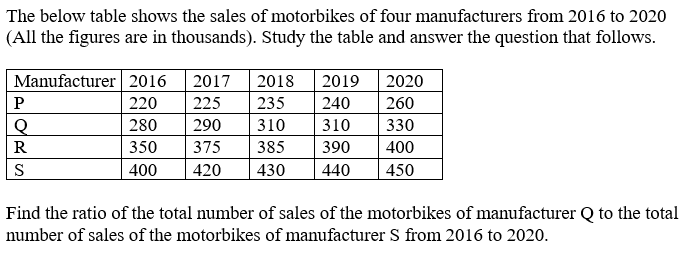
The below table shows the sales of motorbikes of four manufacturers from 2016 to 2020 (All the figures are in thousands). Study the table and answer the question that follows. Manufacturer → 2016 | 2017 | 2018 | 2019 | 2020 P — 220 | 225 | 235 | 240 | 260 Q — 280 | 290 | 310 | 310 | 330 R — 350 | 375 | 385 | 390 | 400 S — 400 | 420 | 430 | 440 | 450 Find the ratio of the total number of sales of the motorbikes of manufacturer Q to the total number of sales of the motorbikes of manufacturer S from 2016 to 2020.
- (a)74 : 103
- (b)76 : 107
- (c)72 : 105
- (d)78 : 107
Answer
Why
Correct — B. The stem is a table: motorbike sales in thousands for manufacturers P, Q, R and S across 2016 to 2020. Add the two rows the question names.
Manufacturer Q: 280 + 290 + 310 + 310 + 330 = 1520
Manufacturer S: 400 + 420 + 430 + 440 + 450 = 2140
Ratio = 1520 : 2140
Both are divisible by 20 → 76 : 107 → option (b).
76 = 4 × 19 and 107 is prime, so this is lowest terms.
Why the others are wrong
- (a)74 : 103 — 74 : 103 works out to 0.7184, above the true 1520⁄2140 = 0.7103. Scaled back up by 20 it reads 1480 : 2060, and neither figure is a row total in the table.
- (c)72 : 105 — 72 : 105 reduces to 24 : 35 = 0.6857, well below the true 0.7103. Its scaled-up form, 1440 : 2100, undercounts both rows.
- (d)78 : 107 — The S term is right — 2140 = 107 × 20 — but the Q term is not. Q totals 1520, which is 76 × 20, whereas 78 × 20 = 1560, forty more than the row holds.
Concept
A ratio drawn from a table is two row-sums and one cancellation. The arithmetic is easy and the marks are lost in the reading.
Find the two rows the question names — here Q and S — and add across all five years, 2016 to 2020, before dividing anything.
Then reduce by the largest factor you can see. Both totals are even and end in a zero, so 20 comes out at once. A decimal check is faster still: 1520⁄2140 is about 0.71, and that alone separates the four options.
The table's note puts all figures in thousands. A unit common to both terms cancels in a ratio, so there is nothing to multiply by 1,000 here — but the same table would need that conversion if the question asked for a count of motorbikes.
Key facts
- Manufacturer Q sold 280, 290, 310, 310 and 330 across 2016 to 2020, totalling 1,520.
- Manufacturer S sold 400, 420, 430, 440 and 450 across the same years, totalling 2,140.
- 1520 : 2140 divides through by 20 to give 76 : 107.
- 107 is prime and does not divide 76, so 76 : 107 cannot be reduced further.
Study next
Common traps
- Adding only the years the eye lands on and missing the repeated 310 in Q's row
- Reading down a year column instead of across a manufacturer's row
- Reducing 1520 : 2140 by 10 to 152 : 214, not finding it listed, and abandoning a correct line
A table gives up its marks to whoever reads the right row; the operation on top of it changes. It is a ratio of two row totals here, an average of a column at Quant Q.22 of this paper, and a comparison against an average at Quant Q.15.
Related PYQs
No directly related past PYQ was found.