
Ajay spends of his income on different household items. If his income increases by 25% and expenditure increase by 20%, then the effect on his savings will be:
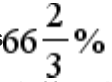
- (a)35%
- (b)49%
- (c)28%
- (d)61%
Answer
Why
Correct — A. The figure in the stem supplies the fraction the text is missing: Ajay spends 66⅔% of his income, which is 2⁄3.
Take income = 300, a multiple of 3 that keeps every figure whole.
Expenditure = 2⁄3 × 300 = 200
Savings = 300 − 200 = 100
Income rises 25%: 300 × 1.25 = 375
Expenditure rises 20%: 200 × 1.20 = 240
New savings = 375 − 240 = 135
Savings go from 100 to 135, a gain of 35 on a base of 100 = 35% increase → option (a).
Why the others are wrong
- (b)49% — 49% would need savings to climb by 49 units from 100. The gain is fixed by the arithmetic: income brings in 75 extra units and expenditure absorbs 40 of them, leaving exactly 35.
- (c)28% — 28% understates the effect. The percentage swing grows with the share already spent, and at a spending fraction of 2⁄3 it comes to 35% — it would drop towards 25% only if Ajay spent a smaller share.
- (d)61% — 61% is far above the true figure. With income at 375 and expenditure at 240, new savings are pinned at 135, and 135 against 100 is a rise of 35%, not 61%.
Concept
Savings are income minus expenditure, so the percentage change in savings is not the difference of the two percentage changes. Working in absolute units is what keeps this straight.
Fix the income at a convenient number, split it into expenditure and savings, apply each rise to its own quantity, then compare new savings with old.
The size of the effect depends on the spending fraction. The more of his income Ajay already spends, the smaller the savings base a fixed extra amount is measured against — and the larger the percentage swing that comes out.
Option (a) is the bare number '35%' with no direction attached, as are all four. The working gives an increase, and the key takes the bare figure as that increase.
The fraction 66⅔% reaches the candidate as an image rather than as text, and the crop clips a sliver at its left edge. The value is legible and it is the one the arithmetic needs.
Key facts
- 66⅔% equals 2⁄3, so Ajay saves the remaining 1⁄3 of his income.
- On an income of 300, expenditure is 200 and savings are 100.
- After the rises income is 375 and expenditure is 240, leaving savings of 135.
- Savings move from 100 to 135, an increase of 35%.
Study next
Common traps
- Subtracting the two rates to get 5% and offering that as the effect on savings
- Applying the 20% rise to income instead of to expenditure
- Measuring the 35-unit gain against the new income of 375 rather than against the old savings of 100
SSC pairs a fraction of income with two unequal growth rates and asks for the effect on what is left over. Percentage change on a stated base is asked again at Quant Q.8 of this paper, where a bar graph gives 140 students in 2018 and 180 in 2019.
Related PYQs
No directly related past PYQ was found.