
If a = xcosθ + ysinθ and b = xsinθ − ycosθ, then a² + b² is equal to:

- (a)
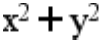
- (b)

- (c)
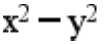
- (d)

Answer
Why
Correct — A. Square each expression and add.
a² = (x cosθ + y sinθ)² = x²cos²θ + 2xy sinθ cosθ + y²sin²θ
b² = (x sinθ − y cosθ)² = x²sin²θ − 2xy sinθ cosθ + y²cos²θ
The cross terms are equal and opposite, so they cancel:
a² + b² = x²(cos²θ + sin²θ) + y²(sin²θ + cos²θ)
Since cos²θ + sin²θ = 1, this collapses to x² + y², the expression on option (a).
Why the others are wrong
- (b)Option (b) shows x + y, which is degree 1 while a² + b² is degree 2. Double x and y and a² + b² quadruples while x + y only doubles, so the two cannot be the same thing.
- (c)Option (c) shows x² − y², the shape you expect if the minus sign in b carried through. It does not: squaring −y cosθ gives +y²cos²θ, so both squares arrive positive.
- (d)Option (d) shows x − y, degree 1 again, and it turns negative whenever y exceeds x. A sum of two squares never does.
Concept
This is the Pythagorean identity sin²θ + cos²θ = 1 hidden inside an algebraic expansion.
Mechanically: expand both squares, watch the 2xy cross terms cancel because one carries a plus and the other a minus, group the x² and y² terms, then apply the identity twice.
Structurally: the map (x, y) → (a, b) here is orthogonal, and orthogonal maps leave x² + y² alone. That is why the answer is free of θ.
The stem and all four options are printed as images in the source paper, so the algebra has to be read off the pictures.
Option (a) reads x² + y², option (b) reads x + y, option (c) reads x² − y², option (d) reads x − y.
Key facts
- sin²θ + cos²θ = 1 for every value of θ.
- If a = x cosθ + y sinθ and b = x sinθ − y cosθ then a² + b² = x² + y², whatever θ is.
- Putting θ = 0 gives a = x and b = −y, so a² + b² = x² + y² — a fast sanity check.
- (p + q)² + (p − q)² = 2p² + 2q² is the same cross-term cancellation in plain algebra.
Study next
Common traps
- Expanding one square carefully and assuming the second behaves identically
- Letting the minus sign inside b survive into the answer as x² − y²
- Testing one convenient value of θ and treating the coincidence as proof without the algebra
SSC sets identity-simplification items with the whole stem as an image, so nothing can be skimmed from the text alone.
A trigonometric simplification of the same family, (cosec θ − sin θ)(sec θ − cos θ)(tan θ + cot θ), runs at 25 Sep 2024, 09:00, Quant Q.1.
Related PYQs
No directly related past PYQ was found.