
Identify the figure given in the options which when put in place of ? will logically complete the series.
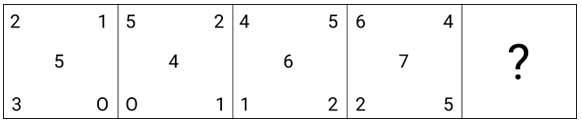
- (a)
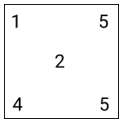
- (b)
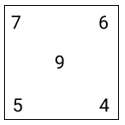
- (c)
- (d)
Answer
Why
Correct — B. Each frame holds five digits in five slots: four corners and a centre. The digits do not change value, they travel along a fixed path.
Rule: centre to top-left, top-left to top-right, top-right to bottom-right, bottom-right to bottom-left, then out — with one new digit entering at the centre.
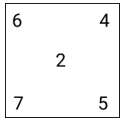
Frame 4 shows 6 top-left, 4 top-right, 7 centre, 2 bottom-left, 5 bottom-right.
So frame 5 must show 7 top-left, 6 top-right, 4 bottom-right and 5 bottom-left.
Option (b) is the figure carrying those four digits in those four places, with the new 9 at the centre.
Why the others are wrong
- (a)Its top-left digit is 1, which left the frames after the third one and cannot come back along the path. It also shows 5 twice, and no frame repeats a digit.
- (c)It runs the same path backwards: 7 goes to the top-right instead of the top-left, 4 moves back to the top-left and 6 drops to the bottom-left.
- (d)It keeps frame 4's top row and bottom-right exactly as they were — 6, 4 and 5 have not moved — and only swaps the centre 7 with the bottom-left 2.
Concept
Digits arranged inside a frame look like arithmetic and are usually motion. Before you test sums, mark which digits survive from one frame to the next and note where each one sits.
Here every surviving digit moves one slot along a fixed circuit, the digit at the end of the circuit is pushed out, and a new digit is dropped into the centre. Frames 1 to 4 obey that without exception.
It fixes four of the five slots in frame 5, and four is all you need to identify an option.
The centre digits run 5, 4, 6, 7 and then 9, and four terms do not establish a rule for that entry sequence.
You do not need one. The four travelling digits already leave a single option standing.
Key facts
- Frame 1 reads 2 top-left, 1 top-right, 5 centre, 3 bottom-left, 0 bottom-right.
- Each frame's centre digit becomes the next frame's top-left digit.
- Each frame's bottom-left digit leaves the series and never returns.
Study next
Common traps
- Testing sums and products of the five digits before checking whether the digits simply move.
- Choosing option (d) because its corners look familiar, when they are frame 4's own corners.
- Reading the circuit in the wrong direction, which produces option (c).
The same instruction line — identify the figure which, put in place of the question mark, logically completes the series — is used at 09 Sep 2024, 12:30, Reasoning Q.13 and at 09 Sep 2024, 16:00, Reasoning Q.24.
Related PYQs
No directly related past PYQ was found.