
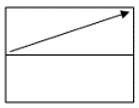
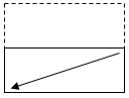
A transparent sheet with a pattern is given below. Select the option that depicts the pattern that would appear when the given transparent sheet is folded at the middle horizontal line.
- (a)
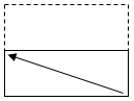
- (b)
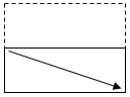
- (c)
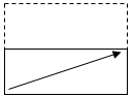
- (d)
Answer
Why
Correct — B.
Rule: folding on the middle horizontal line mirrors the pattern top to bottom. The top edge lands on the bottom edge, and a point already on the crease does not move.
The arrow's tail sits at the left end on the crease, so it stays where it is — top-left of the lower half.
The arrowhead sits at the top-right corner, the point farthest from the crease, so it swings down to the bottom-right corner.
The fold therefore gives a line sloping down to the right with the head at the bottom-right: option (b).
Why the others are wrong
- (a)Option (a) draws the same sloping line but puts the arrowhead at the top-left, back on the crease. The head started at the top-right corner, so the fold has to carry it to the bottom edge.
- (c)Option (c) slides the pattern down without mirroring it — the head still points up and to the right, finishing at the crease. A fold reflects a pattern, it does not translate it.
- (d)Option (d) sends the head to the bottom-left. That adds a left-right flip to the top-bottom one, and a horizontal crease leaves left and right exactly where they were.
Concept
A transparent sheet folded on a crease is a reflection, and the reflection is about that crease only.
For a horizontal crease the y-coordinate flips and the x-coordinate is untouched: the top edge maps to the bottom edge, the crease maps to itself, and nothing moves sideways.
Because the sheet is transparent, whatever is on the folded half shows through onto the half beneath, so the answer carries both halves' ink. Here the lower half is blank, so only the mirrored arrow appears.
The item tests direction as much as position.
The options split two and two by slant: (a) and (b) both draw the line falling to the right, (c) and (d) both draw it rising to the right.
Mirroring the stem's rising line about a horizontal crease makes it fall, so the slant alone removes (c) and (d). The arrowhead then decides between (a) and (b).
Key facts
- A fold about a horizontal crease reverses top and bottom and leaves left and right unchanged.
- Any point lying on the crease stays exactly where it is.
- On a transparent sheet the folded half shows through, so both halves' marks appear in the result.
Study next
Common traps
- Sliding the pattern down instead of reflecting it
- Reflecting the line correctly but leaving the arrowhead on its original end
The transparent-sheet-folded-at-the-middle-horizontal-line stem is also asked 17 Sep 2024, 12:30, Reasoning Q.5 and 23 Sep 2024, 09:00, Reasoning Q.13.
Related PYQs
No directly related past PYQ was found.