
Select the figure from among the given options that can replace the question mark (?) in the following series.

- (a)
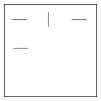
- (b)
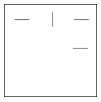
- (c)

- (d)

Answer
Why
Correct — D. Rule: one stroke is added per figure, cells fill left to right along the top row and then the second row, and the stroke alternates horizontal, vertical, horizontal.
Figure 1: a horizontal dash in the first cell.
Figure 2: adds a vertical dash in the second cell.
Figure 3: adds a horizontal dash in the third cell.
Figure 4: adds a vertical dash at the left end of the second row.
The fifth figure therefore keeps those four strokes and adds a horizontal dash in the middle cell of the second row, five marks in all. That is option (d).
Why the others are wrong
- (a)Option (a) still carries four strokes, and it turns Figure 4's vertical dash into a horizontal one. The series only adds marks, it never redraws one already there.
- (b)Option (b) keeps four strokes and moves the second-row dash to the right-hand cell as a horizontal. Cells fill left to right, so the second row starts at its left end.
- (c)Option (c) also stops at four strokes, shifting Figure 4's vertical dash across to the right-hand cell rather than adding a fifth mark anywhere.
Concept
A growth series adds a fixed amount of ink per step, and the work is deciding where the new mark goes and what shape it takes.
Read position and shape as two separate rules. Position here follows reading order across an implied grid of three columns. Shape alternates between a horizontal and a vertical dash.
Once both rules are named, simply counting the marks in each option settles most of the choices before you compare anything else.
Nothing in the stem draws the grid — the cells are implied by where the existing dashes sit. Sketching that grid on the rough sheet is quicker than eyeballing four near-identical options.
Key facts
- Figure 4 carries four strokes, so the answer must carry five.
- The strokes so far read horizontal, vertical, horizontal, vertical, which fixes the fifth as horizontal.
- Figure 4 opened the second row at its left-hand cell, so the fifth stroke lands in the middle cell of that row.
Study next
Common traps
- Choosing a figure that redraws an existing stroke instead of adding a new one.
- Forgetting the alternation and adding a vertical dash as the fifth stroke.
- Filling the second row from the right.
Picture series and picture pattern sit close together in these papers. Reasoning Q.13 of the same 13 Sep 2024, 12:30 paper asks you to complete a symmetric pattern rather than a sequence, and Reasoning Q.19 of that paper runs a figure analogy.
Related PYQs
No directly related past PYQ was found.