
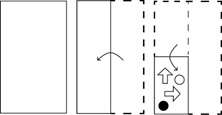
The sequence of folding a paper and the manner in which the folded paper is cut is shown in the following figures. How would this paper look when unfolded?
- (a)
- (b)
- (c)
- (d)
Answer
Why
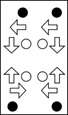
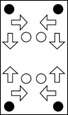
Correct — D. Rule: unfold in reverse order, mirroring the punched quarter across each crease in turn.
The right half folds onto the left, then the top folds onto the bottom, so the punched piece is the bottom-left quarter. It carries an up-arrow at its outer top, a circle beside it, a right-arrow below them, and a filled dot at its outer bottom corner.
Undo the top-to-bottom fold first. The upper-left quarter is that cluster flipped vertically, so the dot rises to the top-left corner and the up-arrow becomes a down-arrow.
Undo the right-to-left fold next. The whole right half is the left half flipped horizontally, which turns every right-arrow into a left-arrow.
Only option (d) shows dots at all four corners with the upper horizontal arrows pointing inward and the down-arrows on the outer edges.
Why the others are wrong
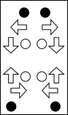
- (a)Option (a) mirrors the punched quarter sideways instead of upward when building the top half. Its two upper dots sit inside the top edge rather than at the corners, and its upper horizontal arrows point outward.
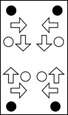
- (b)Option (b) gets the corner dots and the inward arrows right, then swaps the circle and the down-arrow inside each upper quarter. The down-arrows belong on the outer edges, directly above the up-arrows below them.
- (c)Option (c) repeats the upper cluster instead of mirroring it, so both upper horizontal arrows point the same way. A fold produces a reflection, never a copy slid across.
Concept
Every fold doubles the paper, so two folds mean four layers and four copies of whatever is punched through them.
The copies are not scattered. Unfold in the reverse of the folding order, and at each step the new half is a mirror image of the half you already have, reflected in that crease.
Direction matters once the punched shape is asymmetric. A vertical crease reverses left-pointing and right-pointing arrows and leaves vertical ones alone. A horizontal crease does the opposite.
The stem draws the folded quarter inside a dashed outline of the whole sheet, which is what tells you where that quarter sat — bottom-left here. Losing that placement turns a solvable item into a guess.
Key facts
- Two folds make four layers, so each punched shape appears four times on the opened sheet.
- A vertical crease reverses left-pointing and right-pointing arrows and leaves vertical arrows unchanged.
- A horizontal crease reverses up-pointing and down-pointing arrows and leaves horizontal arrows unchanged.
- The dot punched at the outer bottom corner of the quarter opens out to all four corners of the sheet.
Study next
Common traps
- Reflecting the quarter across the wrong crease first, which is what option (a) shows.
- Treating the unfold as a copy slid across rather than a mirror image.
- Keeping an arrow's direction when the crease it crosses reverses it.
SSC prints this item under more than one wording. Reasoning Q.9 of the same 13 Sep 2024, 12:30 paper says simply that a paper is folded and cut, while the folding-sequence wording used here returns at 10 Sep 2024, 16:00, Reasoning Q.8.
Related PYQs
No directly related past PYQ was found.