
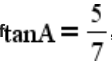
If , then find the value of
- (a)

- (b)

- (c)

- (d)

Answer
Why
Correct — B. Divide the numerator and the denominator by cosA. Every term then becomes tanA, which is the one quantity you were given.
(7sinA − 3cosA) ⁄ (7sinA + 3cosA)
= (7tanA − 3) ⁄ (7tanA + 3)
Put tanA = 5⁄7, so 7tanA = 5:
= (5 − 3) ⁄ (5 + 3)
= 2⁄8 = 1⁄4
Then add the 4 printed outside the fraction:
1⁄4 + 4 = 4¼ → option (b)
Why the others are wrong
- (a)7⅓ misses on both halves. The number added outside the fraction is 4, not 7, and the fraction itself reduces to 1⁄4 — nothing in the working divides by 3.
- (c)3 5⁄7 hands back the printed 5⁄7. That ratio is tanA, not the value of the fraction — substituted into (7tanA − 3)⁄(7tanA + 3) it gives 2⁄8 = 1⁄4, and the number outside is 4.
- (d)3 1⁄5 needs the fraction to be 1⁄5, which comes from a denominator of 10. The denominator is 7tanA + 3 = 8, so the fraction is 2⁄8 = 1⁄4.
Concept
The expression is homogeneous: every term upstairs and downstairs has degree one in sinA and cosA. Divide through by the highest power of cosA and the whole ratio collapses into tanA.
That is why the question gives tanA and nothing else. You never need sinA or cosA separately, and you never need to build the 5–7–√74 right triangle behind tanA = 5⁄7.
The trailing + 4 sits outside the fraction, not inside it. Read the whole expression once before you start, or the working ends correctly at 1⁄4 and the answer is still wrong.
Both the given ratio and the expression are printed as images in this item, so the + 4 is easy to skip on a first read. The numbers are chosen so 7tanA is the whole number 5, which is the signal that substitution, not triangle-building, is the intended route.
Key facts
- Dividing a homogeneous sin-cos ratio by cosA turns every term into tanA.
- (7sinA − 3cosA)⁄(7sinA + 3cosA) = (7tanA − 3)⁄(7tanA + 3).
- With tanA = 5⁄7 the fraction is 2⁄8 = 1⁄4, so the expression equals 4¼.
- tanA = 5⁄7 corresponds to a right triangle with legs 5 and 7 and hypotenuse √74.
Study next
Common traps
- Answering 1⁄4 and forgetting the + 4 printed outside the fraction.
- Cancelling the 7 of 7sinA against the 7 in 5⁄7 before dividing by cosA.
- Building the √74 triangle to get sinA and cosA — valid, but the long way round.
Given tanA, evaluate a sin-cos expression — that is the family, and here the triangle is not wanted.
17 Sep 2024, 09:00, Quant Q.22 belongs to it: tanA = 1, evaluate 4 sinA cosA. That one is a product, though, so there is nothing to divide by cosA — read tanA = 1 as A = 45°, or write the expression over sin²A + cos²A and divide through by cos²A.
When the given ratio is tidy enough for the substitution to land on whole numbers — 7tanA = 5 here — that is your cue that no triangle is needed.
Related PYQs
No directly related past PYQ was found.