
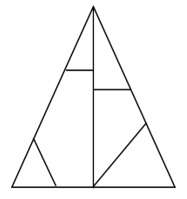
What is the number of triangles in the following figure?
- (a)9
- (b)7
- (c)6
- (d)8
Answer
Why
Correct — D. Count by construction, not by eye.
Label the big triangle A (apex), B (bottom-left), C (bottom-right). The vertical from A meets BC at its midpoint M.
The upper horizontal runs from P on AB across to Q on the vertical. The lower horizontal runs from R on the vertical across to S on AC. One slant runs from T on AB down to U on BC; another runs from M up to V on AC.
Rule: a triangle exists only where three drawn segments close on one another.
Full height: ABC, ABM, AMC.
Under the two horizontals: APQ, ARS.
Cut off by the slants: BTU, AMV, MVC.
That is 3 + 2 + 3 = 8, option (d).
Why the others are wrong
- (a)9 — 9 counts a region that has more than three sides. R–M–V–S, below the lower horizontal and right of the vertical, is a quadrilateral; P–T–U–M–Q on the left is a pentagon.
- (b)7 — 7 is what you get after missing AMV — the vertical, the slant M to V, and the stretch of AC from V up to A do close a triangle, even though the lower horizontal cuts across it.
- (c)6 — 6 drops the two halves ABM and AMC. The vertical from A to M splits the whole figure in two, and each half is itself a triangle.
Concept
Counting figures is bookkeeping, not spotting. Name every intersection point first, then sweep in size order: the whole figure, then the halves, then whatever each added line cuts off on its own.
The test to apply to each candidate is whether all three of its sides lie along segments actually drawn. Regions that look triangular often have a fourth side where an added line stops short of the boundary.
Working in size order also stops the commonest error, which is forgetting to count the outer triangle itself.
Both short horizontals here stop on the central vertical instead of crossing it. That is why each of them cuts off exactly one small triangle at the top rather than splitting the figure across its width.
Key facts
- The eight triangles are ABC, ABM, AMC, APQ, ARS, BTU, AMV and MVC.
- A region counts only if each of its three sides lies along a segment drawn in the figure.
- A line from the apex to the base turns one triangle into three: the two halves and the original.
Study next
Common traps
- Counting R–M–V–S as a triangle when it has four sides.
- Forgetting the outer triangle ABC.
- Missing AMV because the lower horizontal runs across it.
Figure work sits alongside the picture items in this Reasoning block: a figure series at Reasoning Q.4, a pattern completion at Q.13, a figure analogy at Q.19, and paper folding at Q.3 and Q.9.
Related PYQs
No directly related past PYQ was found.