
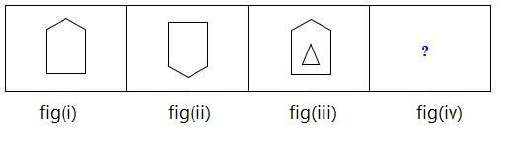
Select the option that is related to the third figure in the same way as the second figure is related to the first figure. Follow the analogy- Figure 1 : Figure 2 :: Figure 3 : ?
- (a)
- (b)
- (c)
- (d)
Answer
Why
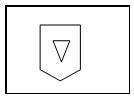
Correct — C. The figure is turned upside down, contents included.
Rule: reflect the whole figure in a horizontal axis — whatever was at the top ends up at the bottom.
fig(i) is a five-sided house outline: a flat base, two vertical sides, a peak at the top. fig(ii) is that outline inverted — flat across the top, vertical sides, and the point now at the bottom.
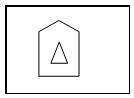
fig(iii) is the same house outline with a small upright triangle drawn inside it.
Inverting it gives a flat top, a point at the bottom, and the inner triangle now pointing down. That is option (c).
Why the others are wrong
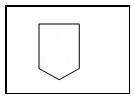
- (a)Option (a) inverts the outline correctly but the inner triangle has disappeared. Nothing in the step from fig(i) to fig(ii) removes content from the figure.
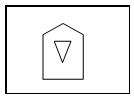
- (b)Option (b) keeps the outline as a house with its peak at the top and turns only the small triangle. The operation acts on the whole figure, outline included.
- (d)Option (d) is fig(iii) redrawn unchanged — peak up, inner triangle up. No transformation has been applied at all.
Concept
A figure analogy asks you to name one operation that carries figure 1 to figure 2, then apply it to figure 3 without improvising.
The operation is nearly always one of a short list: rotate by a stated angle, reflect in a vertical or horizontal axis, add or delete an element, or shade something.
Here the outline is symmetric about its vertical axis, so a 180-degree rotation and a horizontal-axis reflection produce the same picture. Either description will do.
What decides the item is that the inner element turns with the outline rather than independently of it.
The options differ on two independent choices: whether the outline is inverted, and whether the inner triangle is inverted. Settling those two choices separately is far quicker than comparing whole pictures side by side.
Key facts
- fig(i) and fig(iii) share the same five-sided outline: flat base, two vertical sides, a peak on top.
- fig(ii) is fig(i) reflected in a horizontal axis, which moves the peak to the bottom.
- A shape symmetric about its vertical axis looks identical after a 180-degree rotation and after a horizontal-axis reflection.
Study next
Common traps
- Turning the inner element but leaving the outline as it was.
- Dropping the inner element because an empty outline looks like a cleaner answer.
- Calling the step a rotation and then rotating by 90 degrees instead of 180.
Picture reasoning runs through this Reasoning block in several forms: Reasoning Q.4 asks for the next figure in a series, Reasoning Q.13 for the figure that completes a pattern, and Reasoning Q.3 and Q.9 are paper-folding items.
Related PYQs
No directly related past PYQ was found.