
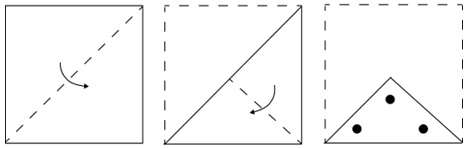
A square sheet of paper is folded along the dotted line successively along the directions shown and is then punched in the last as shown. How would the paper look when unfolded?
- (a)
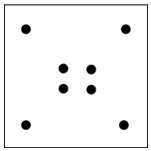
- (b)
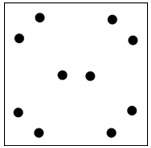
- (c)
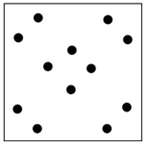
- (d)
Answer
Why
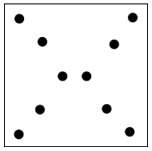
Correct — C. Two folds means every punch reappears four times, so three punches must open twelve holes.
Fold 1 turns the top-left half over the diagonal running from the bottom-left corner to the top-right corner.
Fold 2 turns the right part over the line joining the middle of that diagonal to the bottom-right corner, leaving a triangle standing on the full bottom edge with its apex at the sheet's centre.
Now unfold in reverse. Undoing fold 2 mirrors each hole across the line to the bottom-right corner; undoing fold 1 mirrors the whole set across the main diagonal.
The two punches near the base give eight holes ringing the sheet in pairs, and the punch near the apex gives four in a small diamond around the centre. Option (c) shows exactly that arrangement.
Why the others are wrong
- (a)Option (a) shows eight holes — four at the corners and four in a square at the centre. Three punches through a sheet folded twice must open twelve, so this figure is four short.
- (b)Option (b) shows ten holes. Its eight outer holes are right, but the apex punch opens only two near the centre where a twice-folded sheet demands four.
- (d)Option (d) shows ten holes and drives four of them into the sheet's corners. No punch in the folded triangle sits at a corner, so no unfolded hole can, and ten is two short of twelve besides.
Concept
Each fold doubles the holes a punch makes. One fold gives 2, two folds give 4, three folds give 8 — so before reading any option, multiply the punches by 2 raised to the number of folds.
Here that is 3 × 4 = 12, and any option with a different count is gone in a second. Counting first is faster than any geometry.
The second step is symmetry. Undoing a fold reflects every hole across that fold's line, so the finished pattern is symmetric about the first fold's line. Both folds here are diagonal, so the answer must be symmetric about the sheet's main diagonal, from the bottom-left corner to the top-right.
This card describes the folds in words because they are given as an image: a square, a diagonal fold from bottom-left to top-right, a second fold along the line from the sheet's centre to the bottom-right corner, and three punches in the resulting triangle.
Key facts
- Three punches and two folds give 3 × 2² = 12 holes.
- Fold 1 is along the main diagonal, from the bottom-left corner to the top-right.
- Fold 2 is along the line from the sheet's centre to the bottom-right corner.
- The unfolded pattern is symmetric about the main diagonal, because that is the first fold's line.
Study next
Common traps
- Counting holes in the options before working out how many there should be.
- Unfolding in the order the folds were made instead of reversing that order.
- Reflecting the holes across the sheet's vertical or horizontal centre line when both folds were diagonal.
The same stem — a square sheet folded along the dotted line successively, then punched — is at 18 Sep 2024, 9:00, Reasoning Q.4 and at 23 Sep 2024, 12:30, Reasoning Q.6.
Working out the expected hole count before looking at the pictures does most of the elimination, as it does here, where one option is short by four and two by two.
Related PYQs
No directly related past PYQ was found.