
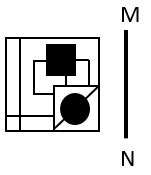
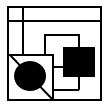
Select the correct mirror image of the given figure when the mirror is placed at MN as shown.
- (a)
- (b)
- (c)
- (d)
Answer
Why
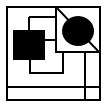
Correct — C. MN is drawn as a vertical line standing to the right of the figure, so the reflection is a left-right flip. Heights are untouched; sides swap.
Three markers settle it. In the given figure the narrow twin-line strip runs down the left edge, the solid black square sits top-centre, and the black circle sits in the lower-right inside a smaller square, crossed by a diagonal that climbs from bottom-left to top-right.
After a left-right flip the strip must be on the right edge, the black square must stay top-centre, and the circle must move to the lower-left with its diagonal now descending from top-left to bottom-right.
Option (c) shows all three, including the reversed diagonal.
Why the others are wrong
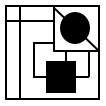
- (a)Option (a) keeps the twin-line strip on the left and lifts the black circle to the top-right. That is a top-bottom flip, which is what a horizontal mirror below the figure gives, not the vertical MN printed here.
- (b)Option (b) lays the twin-line strip horizontally along the bottom and puts the black square at the left-middle. A reflection preserves a stroke's direction, so a strip turned through 90 degrees means a rotation.
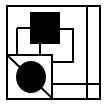
- (d)Option (d) sends the twin-line strip to the top as a horizontal band and the black square to the right-middle. Again the strip has rotated rather than reflected, so the figure cannot be the mirror image.
Concept
A mirror image is a reflection across MN, and the line's direction decides everything. A vertical MN swaps left and right and leaves top and bottom alone; a horizontal MN does the reverse.
Do not try to redraw the figure. Pick two or three asymmetric markers — an edge strip, a filled shape, a diagonal — and work out where each must land. An option that misplaces one marker is out, whatever else it gets right.
Diagonals are the most reliable marker of the three, because a reflection reverses a diagonal's slope while a rotation can preserve it.
The figure is an image on the page, so this card describes it in words: the elements are a framed square, a narrow twin-line strip down one edge, a solid black square, and a black circle inside a smaller square crossed by a diagonal.
Key facts
- MN here is vertical and stands to the right of the figure, so the transformation is a left-right flip.
- A vertical mirror leaves every element at the same height.
- The diagonal through the black circle climbs left to right in the given figure and must descend left to right in its mirror.
- A rotation can move a shape to the opposite side without reversing any diagonal, which is what separates it from a reflection.
Study next
Common traps
- Treating the mirror image as a 180-degree rotation, which also moves left to right but inverts top and bottom too.
- Comparing only the large filled shapes and skipping the thin edge strip, which is what separates the options here.
- Flipping the figure but leaving the diagonal's slope unreversed.
The MN mirror is a standing figural format in CGL 2024 Tier-I. The same stem, with MN drawn beside the figure, is at 11 Sep 2024, 9:00, Reasoning Q.12 and at 11 Sep 2024, 12:30, Reasoning Q.10.
Some shifts print the stem without the words 'as shown' — 10 Sep 2024, 12:30, Reasoning Q.8 is one — so look at the figure to find which way MN runs before choosing.
Related PYQs
No directly related past PYQ was found.