
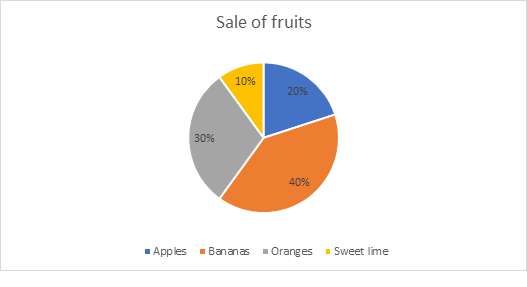
The pie chart below shows the per cent sale of different fruits in a day for a shop. If the total number of fruits sold by a fruit seller in a day is 1200, what is the combined central angle in the pie chart for oranges and apples?
- (a)90
- (b)180
- (c)220
- (d)160
Answer
Why
Correct — B. The pie chart labels the four slices apples 20%, bananas 40%, oranges 30% and sweet lime 10%.
Oranges + apples = 30% + 20% = 50%
A full pie spans 360 degrees
50% of 360 = 0.5 × 360 = 180 degrees → option (b)
The 1200 fruits are never used: a central angle depends on the share, not on the count behind it.
Why the others are wrong
- (a)90 — 90 degrees is a quarter of the pie, that is 25%. Oranges and apples together are 30% + 20% = 50%, which is half the circle and so twice this angle.
- (c)220 — 220 degrees means 220 ⁄ 360 = 61.1% of the sale. The four shares on the chart are 20, 40, 30 and 10, and no pair of them adds to 61.1%.
- (d)160 — 160 degrees means 160 ⁄ 360 = 44.4%. Again no pair of the chart's shares reaches it — oranges and apples give exactly 50%, and 50% of 360 is 180.
Concept
A pie chart turns a share into an angle through one fixed multiplier: 1% = 3.6 degrees, because 100% has to fill 360 degrees.
So any percentage becomes an angle by multiplying by 3.6, and any angle becomes a percentage by dividing by it. Oranges and apples are 30 + 20 = 50, and 50 × 3.6 = 180.
The absolute total changes how many fruits sit inside a slice — 30% of 1200 is 360 oranges — but it cannot change how wide the slice is drawn.
The 1200 total is a live decoy. It is the right number for a question about how many oranges were sold, and the wrong number for a question about an angle, which is why the stem supplies it.
Key facts
- 1% of a pie chart equals 3.6 degrees, since 100% fills 360 degrees.
- This chart reads apples 20%, bananas 40%, oranges 30%, sweet lime 10%, adding to 100%.
- Oranges and apples together take 50% of the pie, so 50% of 360 = 180 degrees.
- 30% of the 1200 fruits sold is 360 oranges — a count, not an angle.
Study next
Common traps
- Feeding the 1200 total into the angle calculation, which the question never needs.
- Matching the legend colours to the wrong slices — the grey 30% wedge is oranges, the blue 20% wedge is apples.
- Answering 50 because the two shares add to 50%, without the ×3.6 conversion to degrees.
This pie-chart stem carries a total the asked quantity does not need, so the first move is to decide whether the answer is an angle, a share or a count. Quant Q.16 of the 13 Sep 2024, 09:00 paper applies the same discipline to a bar graph and Quant Q.19 to a commodity table.
Related PYQs
No directly related past PYQ was found.