
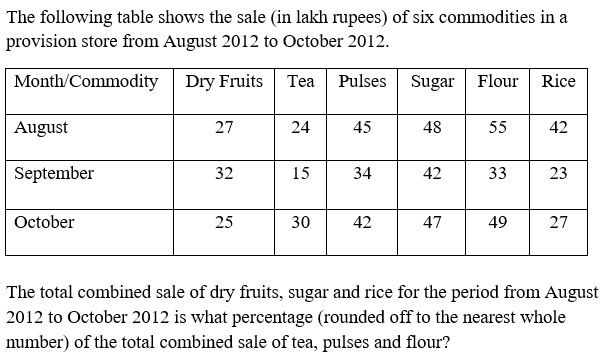
The following table shows the sale (in lakh rupees) of six commodities in a provision store from August 2012 to October 2012. Month/Commodity | Dry Fruits | Tea | Pulses | Sugar | Flour | Rice August | 27 | 24 | 45 | 48 | 55 | 42 September | 32 | 15 | 34 | 42 | 33 | 23 October | 25 | 30 | 42 | 47 | 49 | 27 The total combined sale of dry fruits, sugar and rice for the period from August 2012 to October 2012 is what percentage (rounded off to the nearest whole number) of the total combined sale of tea, pulses and flour?
- (a)94%
- (b)98%
- (c)96%
- (d)95%
Answer
Why
Correct — C. Total each commodity down all three months first, then compare the two groups.
Dry fruits: 27 + 32 + 25 = 84
Sugar: 48 + 42 + 47 = 137
Rice: 42 + 23 + 27 = 92
First group = 84 + 137 + 92 = 313
Tea: 24 + 15 + 30 = 69
Pulses: 45 + 34 + 42 = 121
Flour: 55 + 33 + 49 = 137
Second group = 69 + 121 + 137 = 327
313 ⁄ 327 × 100 = 95.72
Rounded to the nearest whole number = 96%, option (c).
Why the others are wrong
- (a)94% — That is August alone: (27 + 48 + 42) ⁄ (24 + 45 + 55) = 117⁄124 = 94.4%. The stem runs from August to October, so all three rows must be summed before dividing.
- (b)98% — 98% of 327 is 320.5, so the first group would have to reach about 320. It totals 313 — fourteen lakh below the second group, a gap of roughly 4% — which puts the ratio near 96.
- (d)95% — The true value is 95.72%, and the stem says rounded off to the nearest whole number. 95.72 rounds up to 96; 95 is what truncating the decimal gives instead of rounding.
Concept
The stem asks what percentage the first group is of the second, so the second group goes in the denominator. Swapping them gives 327 ⁄ 313 = 104.5%, a different quantity entirely.
The arithmetic is a three-month column total for each of six commodities, then two sums of three. Nothing here is a shortcut — the only saving is adding down a column once and reusing it.
Sugar and flour both total 137 lakh rupees over the three months, which is a useful check that the columns were added correctly.
The table is an image. If it fails to load, the rows read: August 27, 24, 45, 48, 55, 42; September 32, 15, 34, 42, 33, 23; October 25, 30, 42, 47, 49, 27 — for dry fruits, tea, pulses, sugar, flour and rice, in lakh rupees.
Key facts
- Dry fruits, sugar and rice total 84 + 137 + 92 = 313 lakh rupees across August to October 2012.
- Tea, pulses and flour total 69 + 121 + 137 = 327 lakh rupees across the same months.
- 313 ⁄ 327 × 100 = 95.72%, which rounds to 96%.
- In 'A is what percentage of B', B is always the denominator.
Study next
Common traps
- Answering from one month's row instead of the three-month total, which gives 94% from August.
- Truncating 95.72 to 95 when the stem asks for rounding off.
- Putting the wrong group in the denominator, which returns 104.5%.
Table-and-percentage is a standing SSC pairing: read the grid, total two blocks, divide, round. Quant Q.1 of the 13 Sep 2024, 09:00 paper runs the same read-then-percentage step on a marks table, and Quant Q.16 does it with averages off a bar graph.
Related PYQs
No directly related past PYQ was found.