
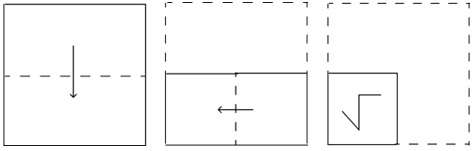
A paper is folded and cut as shown below. How will it appear when unfolded?
- (a)
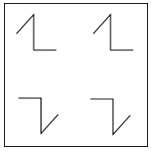
- (b)
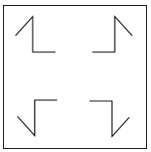
- (c)
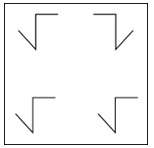
- (d)
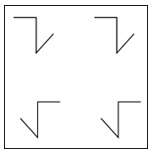
Answer
Why
Correct — B. Undo the folds in reverse order, mirroring the cut across each crease as you open it.
Rule: each unfold reflects the mark across the crease being opened, so two folds turn one cut into four marks, one per quarter.
The panels fold the top half down onto the bottom half, then the right half left onto the left half, so the cut sits in the bottom-left quarter. The mark there is a radical-sign shape: a short diagonal rising to the left from the foot, a vertical, and a bar running right from the top.
Open the vertical crease and the bottom-right quarter carries the left-right reversal of that mark. Open the horizontal crease and both marks reappear in the upper half turned upside down, bar at the bottom.
Option (b) is the sheet that shows all four: within each row the right mark is the left mark reversed, and the upper row is the lower row turned over.
Why the others are wrong
- (a)Option (a) repeats the identical mark in each row instead of reversing it. The vertical crease requires the right-hand mark of a row to be the mirror of the left-hand one.
- (c)In option (c) all four marks keep the bar at the top and the diagonal at the foot, so the horizontal crease has been ignored and the upper half is never turned over.
- (d)Option (d) keeps the bar at the top in every quarter and merely swaps its direction between the rows. The horizontal crease must turn the upper marks upside down.
Concept
Paper folding and cutting is reflection, not rotation. A crease is a mirror line, so opening a fold copies every cut across that line and leaves the original where it was.
Because the copies are made one crease at a time, you must open in the reverse order of the folding: the last crease made is the first one undone. Two folds double the marks twice, giving four, and their arrangement is fixed — each pair straddles the crease that produced it.
The four options differ only in how the mark is turned in each quarter, never in the mark itself. So the whole question is a test of two reflections, and the fastest route is to fix the quarter the cut was made in and work outward from it.
Key facts
- Each fold doubles the number of cut marks, so two folds turn one cut into four.
- You unfold in the reverse order of folding, mirroring across the most recent crease first.
- A reflection across a vertical crease keeps a mark at the same height and swaps its left for its right.
Study next
Common traps
- Rotating the mark by 180 degrees instead of reflecting it.
- Opening the folds in the same order they were made, which lands the copies on the wrong sides.
- Checking only the quarter the cut was made in, which every option gets right or wrong for a different reason.
SSC prints the fold sequence as a strip of panels with arrows and asks for the opened sheet. The same set-up appears on 11 Sep 2024, 16:00, Reasoning Q.10 and on 11 Sep 2024, 09:00, Reasoning Q.15.
Related PYQs
No directly related past PYQ was found.