
Find the value of the following expression.

- (a)

- (b)
- (c)

- (d)
Answer
Why
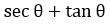
Correct — B. Multiply the fraction under the root, top and bottom, by (1 + sin θ).
(1 + sin θ) ⁄ (1 − sin θ) = (1 + sin θ)² ⁄ (1 − sin²θ)
1 − sin²θ = cos²θ
So the root is √[(1 + sin θ)² ⁄ cos²θ] = (1 + sin θ) ⁄ cos θ
Split it: 1 ⁄ cos θ + sin θ ⁄ cos θ = sec θ + tan θ → option (b)
Check at θ = 30°: (1 + 0.5) ⁄ (1 − 0.5) = 3 and √3 ≈ 1.732, while sec 30° + tan 30° ≈ 1.155 + 0.577 = 1.732.
Why the others are wrong
- (a)cosec θ + cot θ is (1 + cos θ) ⁄ sin θ, the value of the cosine twin √[(1 + cos θ) ⁄ (1 − cos θ)]. At 30° it is about 3.73, not 1.73.
- (c)cosec θ + tan θ mixes the two families: 1 ⁄ sin θ and sin θ ⁄ cos θ share no denominator and never combine into this root. At 30° it is about 2.58.
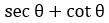
- (d)sec θ + cot θ keeps the right first term and spoils the second. Splitting (1 + sin θ) ⁄ cos θ gives sin θ ⁄ cos θ, which is tan θ. At 30° it is about 2.89.
Concept
The whole item is one manoeuvre: multiply by the conjugate. (1 − sin θ)(1 + sin θ) is 1 − sin²θ, which is cos²θ, and a square root over a perfect square disappears.
What is left, (1 + sin θ) ⁄ cos θ, splits into sec θ + tan θ. The pair is worth memorising, because the same shape returns as √[(1 − sin θ) ⁄ (1 + sin θ)] = sec θ − tan θ.
The cosine version behaves identically and produces cosec θ + cot θ, which is why that appears among the options.
The stem and all four options are printed as images, so a text-only view of this row shows an empty question and blank options. The stem is √[(1 + sin θ) ⁄ (1 − sin θ)] and the options read cosec θ + cot θ, sec θ + tan θ, cosec θ + tan θ and sec θ + cot θ.
Strictly, (1 + sin θ) ⁄ cos θ is the value only where cos θ is positive, since √(x²) is the modulus of x. The paper leaves the quadrant unstated.
Key facts
- √[(1 + sin θ) ⁄ (1 − sin θ)] = sec θ + tan θ.
- √[(1 − sin θ) ⁄ (1 + sin θ)] = sec θ − tan θ, and the two expressions multiply to sec²θ − tan²θ = 1.
- (1 − sin θ)(1 + sin θ) = 1 − sin²θ = cos²θ.
Study next
Common traps
- Multiplying by (1 − sin θ) instead of (1 + sin θ), which leaves the root no simpler.
- Splitting (1 + sin θ) ⁄ cos θ into sec θ + sin θ and losing the cos θ under the second term.
- Answering with the cosec-cot pair, which is the cosine version of the same identity.
SSC prints the expression and all four options as pictures, and the four options pair sec or cosec with tan or cot in every combination — so the identity itself is the only thing separating them.
Identity manipulation of the same kind is asked at Quant Q.21 of this paper and at Quant Q.1 of 25 Sep 2024, 09:00.
Related PYQs
No directly related past PYQ was found.