
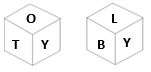
Two different positions of the same dice with faces T, O, B, L, Y and V are shown below. Select the letter that will be on the face opposite to the one having L.
- (a)O
- (b)Y
- (c)V
- (d)B
Answer
Why
Correct — A. Y shows on the right-hand face in both pictures, so hold Y still and turn the die about it.
Rule: faces seen together are adjacent, and each face has exactly four neighbours.
View 1 puts O and T beside Y; view 2 puts L and B beside Y. That is four different letters touching Y, so Y's four neighbours are used up and the hidden face opposite Y is V.
In each view the top face is followed by the left face as you go round Y: O is followed by T, and L is followed by B. The only four-face ring holding both runs O → T → L → B → O.
In a ring of four, faces two steps apart are opposite. O and L are two apart, so L is opposite O — option (a). T and B are the other pair.
Why the others are wrong
- (b)Y — Y is the face we held still, and view 2 shows L and Y on the same die at the same time. Faces visible together are adjacent, never opposite.
- (c)V — V is tempting because it appears in neither picture, but V is the face opposite Y: O, T, L and B have already taken all four of Y's neighbours.
- (d)B — B stands next to L in view 2, B on the front-left and L on top. Two faces shown in one picture touch each other, so they cannot be an opposite pair.
Concept
Two-view dice questions are solved by finding what has not moved. If one letter sits in the same position in both pictures, the die has simply been turned about that face, and the other four faces circle it in a fixed order.
Two facts do all the work. Any face shown together with another in one picture is adjacent to it, never opposite. And a face has exactly four neighbours, so as soon as four distinct letters are seen touching it, the sixth letter must be its opposite.
Y being on the right in both views is what makes the single-rotation reading available. When no letter repeats its position, you fall back on listing adjacencies picture by picture and eliminating.
Key facts
- A cube face is adjacent to exactly four faces and opposite exactly one.
- Letters seen in the same picture are adjacent, so they can never be an opposite pair.
- On this die the opposite pairs are O with L, T with B, and Y with V.
Study next
Common traps
- Picking V because it is the letter never shown, when V is opposite Y rather than L.
- Treating the second picture as a different die instead of the same one turned.
- Assuming the die was flipped over, which breaks the fixed circling order.
The same two-position frame runs at 11 Sep 2024, 16:00, Reasoning Q.2 (faces R, P, T, S, M, B) and at 26 Sep 2024, 12:30, Reasoning Q.18 (faces Z, G, M, F, H, S). Reasoning Q.13 of this shift gives three positions of a word-die instead, which needs the adjacency list rather than one turn.
Related PYQs
No directly related past PYQ was found.