
Identify the figure given in the options which when put in place of ‘?’ will logically complete the series.

- (a)
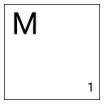
- (b)
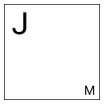
- (c)
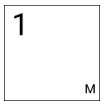
- (d)
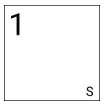
Answer
Why
Correct — B. The series is carried by the small mark in the bottom-right corner of each box, not by the large figure.
Rule: the corner mark of one box becomes the large figure of the next, flipped top-to-bottom.
Box 1's corner arrow points up and box 2's large arrow points down. Box 2's corner triangle points up and box 3's large triangle points down.
Box 3's corner holds a small s and box 4's large figure is a backwards S. That step proves the move is a flip and not a half turn, because a turned s still reads s.
Box 4's corner mark is a single stroke with its hook at the top, curving left. Flip it and the hook swings to the bottom, giving a J — option (b).
Why the others are wrong
- (a)The large figure decides the item, and M is not the corner mark under any flip: the mark is one stroke with a single hook, and M has four strokes.
- (c)1 is the corner mark enlarged but never flipped — its hook still sits at the top. Turning the mark over drops the hook to the bottom, which draws a J.
- (d)1 again, upright, with the hook still at the top. Whatever sits in its own corner cannot make up for the wrong large figure, which the previous box fixes.
Concept
Figure-series boxes here carry two independent channels: a large figure at the top-left and a small mark in the bottom-right corner. Read the corners first, because in this family they are what moves the series forward.
The transformation is a reflection in a horizontal line — a top-to-bottom flip — and not a 180 degree rotation. The two are indistinguishable on a shape symmetric about its vertical axis, such as an arrow or a triangle, and separate only on an asymmetric one.
That is why the s matters. It is the one box that tells you which of the two moves you are watching.
The stem is an image of five boxes. If it fails to load, the series reads: star with a corner up-arrow; large down-arrow with a corner triangle; large down-triangle with a corner s; large backwards S with a corner stroke hooked at the top; then the box to be filled.
Key facts
- A top-to-bottom flip and a 180 degree rotation agree only on shapes symmetric about their vertical axis.
- Flipping a lowercase s top-to-bottom gives a backwards S, because s already has half-turn symmetry.
- A stroke hooked at the top becomes a J when it is flipped top-to-bottom.
Study next
Common traps
- Comparing only the large figures and never reading the corner marks.
- Calling the change a 180 degree rotation, which fits the arrow and the triangle but fails on the s.
- Choosing on the corner mark of the answer box, which nothing in the series fixes.
Reflection also drives Reasoning Q.21 and Q.25 of this shift, where a mirror line MN is drawn beside a row of characters — the same flip applied to a whole row instead of one mark.
Related PYQs
No directly related past PYQ was found.