
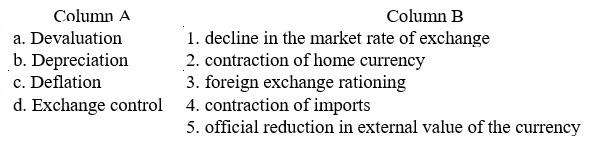
Match the concepts in column A with their respective descriptions in column B.
- (a)a-5, b-1, c-2, d-3
- (b)a-2, b-3, c-4, d-1
- (c)a-5, b-3, c-2, d-1
- (d)a-2, b-1, c-4, d-3
Answer
Why
Correct — A. Take the four one at a time.
Devaluation is an official cut in a currency's external value by the authorities under a fixed rate — B-5.
Depreciation is the same fall left to the market — B-1, the decline in the market rate of exchange.
Deflation contracts money and prices at home — B-2.
Exchange control is the state rationing foreign exchange — B-3.
That gives a-5, b-1, c-2, d-3. B-4, contraction of imports, is left unused — it is the result these measures aim at, not a definition of any of them. Option (a).
Why the others are wrong
- (b)a-2, b-3, c-4, d-1 — Every one of its four pairings fails. The plainest is devaluation as B-2, contraction of home currency, which is deflation's description — devaluation acts on the exchange rate, not on the domestic money supply.
- (c)a-5, b-3, c-2, d-1 — Two faults, not one. It makes depreciation foreign exchange rationing (B-3) — depreciation is a market outcome, not an administrative control — and it also gives exchange control B-1, the decline in the market rate.
- (d)a-2, b-1, c-4, d-3 — Two faults, not one. Deflation is not contraction of imports (B-4) — it is a fall in money supply and in the general price level — and devaluation is not contraction of home currency (B-2), which describes deflation.
Concept
All four terms come from the standard list of measures for correcting a balance of payments deficit.
Devaluation and exchange control are things a government does. Depreciation is not an act at all — it is what the market does to a floating currency.
Deflation works on the home economy instead of the exchange rate: squeeze money and prices, and exports get cheaper abroad while imports fall. That falling-imports effect is what B-4 describes, which is why it makes a good spare entry.
The two columns are supplied as an image in the paper. Column A lists devaluation, depreciation, deflation and exchange control; Column B lists five descriptions against four concepts, so one description must go unused.
Key facts
- Devaluation is an official reduction of a currency's external value under a fixed or pegged rate.
- Depreciation is a fall in a currency's value produced by market forces under a floating rate.
- Deflation is a contraction of money supply accompanied by a fall in the general price level.
- Exchange control means the state rations foreign exchange and allots it to approved uses.
Study next
Common traps
- Using devaluation and depreciation as synonyms — the exam separates them by who acts.
- Expecting every entry in the longer column to be used in a match-the-columns item.
The word depreciation carries a second, unrelated meaning in national income accounting, and SSC uses that one too — 25 Sep 2024, 09:00, GA Q.21 keys NDP = GDP minus depreciation.
Check which chapter the question is standing in before you answer.
Related PYQs
No directly related past PYQ was found.