
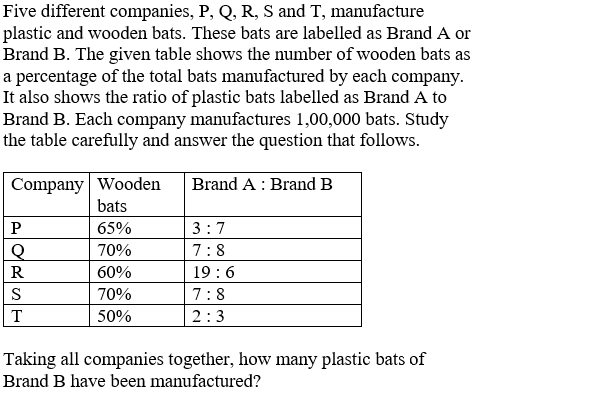
Five different companies, P, Q, R, S and T, manufacture plastic and wooden bats. These bats are labelled as Brand A or Brand B. The given table shows the number of wooden bats as a percentage of the total bats manufactured by each company. It also shows the ratio of plastic bats labelled as Brand A to Brand B. Each company manufactures 1,00,000 bats. Study the table carefully and answer the question that follows. Company → Wooden bats | Brand A : Brand B P — 65% | 3 : 7 Q — 70% | 7 : 8 R — 60% | 19 : 6 S — 70% | 7 : 8 T — 50% | 2 : 3 Taking all companies together, how many plastic bats of Brand B have been manufactured?
- (a)96,100
- (b)86,100
- (c)80,500
- (d)90,500
Answer
Why
Correct — A. Plastic bats = 1,00,000 − wooden bats, and Brand B is the second part of each ratio.
P: 35% plastic = 35,000, B = 7⁄10 × 35,000 = 24,500
Q: 30% plastic = 30,000, B = 8⁄15 × 30,000 = 16,000
R: 40% plastic = 40,000, B = 6⁄25 × 40,000 = 9,600
S: 30% plastic = 30,000, B = 8⁄15 × 30,000 = 16,000
T: 50% plastic = 50,000, B = 3⁄5 × 50,000 = 30,000
Total = 24,500 + 16,000 + 9,600 + 16,000 + 30,000 = 96,100 → option (a)
Why the others are wrong
- (b)86,100 — 86,100 is 10,000 short, exactly what happens if T's 2 : 3 is read as B : A. Brand A is written first, so T's Brand B share is 3⁄5 of 50,000, which is 30,000.
- (c)80,500 — 80,500 falls 15,600 below the total, and no company's Brand B share is 15,600 — they are 24,500, 16,000, 9,600, 16,000 and 30,000. Re-add rather than re-derive.
- (d)90,500 — 90,500 is 5,600 short of the sum. Watch company R: 60% wooden leaves 40% plastic, so 40,000 bats, of which 6⁄25 — that is 9,600 — carry Brand B.
Concept
The table gives wooden bats as a percentage and the brand split as a ratio, and the two act on different bases.
The percentage is of all 1,00,000 bats. The ratio applies only to the plastic bats that are left, so every row needs two steps: subtract the wooden share, then take the Brand B part of what remains.
The ratio denominators change from row to row — 10 for P, 15 for Q and S, 25 for R, 5 for T — so no single multiplier works down the table.
Every company manufactures the same 1,00,000 bats, which is what lets the five results be added straight. If the totals differed, each row would need its own base first.
Key facts
- Each of the five companies manufactures 1,00,000 bats.
- Plastic bats = 1,00,000 − wooden bats, and wooden is given as a percentage of the total.
- The Brand B plastic bats are 24,500 for P, 16,000 for Q, 9,600 for R, 16,000 for S and 30,000 for T.
Study next
Common traps
- Applying the Brand A : Brand B ratio to all 1,00,000 bats instead of to the plastic ones.
- Reading the ratio as B : A and taking the first part.
- Using the wooden percentage as the plastic count.
SSC's table DI typically hides the base — here the ratio applies to plastic bats, not to the 1,00,000 headline. Quant Q.11 of this same shift is the bar-graph version of the same two-step read.
Related PYQs
No directly related past PYQ was found.