
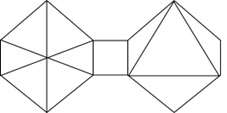
How many triangles are there in the given figure?
- (a)10
- (b)9
- (c)12
- (d)11
Answer
Why
Correct — A. Rule: count block by block, then ask separately whether any two regions merge into a bigger triangle.
The figure is three shapes joined left to right: a hexagon, a small square, and a second six-sided figure.
Left hexagon: all three long diagonals are drawn and meet at the centre, cutting it into 6 triangles. Two neighbours always share a diagonal that runs straight on through the centre, so joining them makes a rhombus, never a larger triangle.
Middle square: 0. No diagonal is drawn inside it.
Right figure: two lines drop from the top apex to the ends of a horizontal base line, splitting the upper part into 3 triangles side by side. Below that base line a fourth closes at the bottom vertex. That is 4.
6 + 0 + 4 = 10, option (a).
Why the others are wrong
- (b)9 — Nine is one short. It comes from reading the apex fan in the right-hand figure as two triangles: the two lines dropping from the apex to the base line create three, not two.
- (c)12 — Twelve overcounts by joining neighbouring segments of the hexagon. Two adjacent segments share a diagonal running straight through the centre, so the pair has four corners and adds nothing.
- (d)11 — Eleven adds one that is not drawn, most simply by letting the square contribute. With no diagonal inside it, the square stays a single four-sided region.
Concept
Counting-figures items are bookkeeping. Split the drawing into its natural blocks first, count inside each block, then ask separately whether any triangle spans two blocks.
Inside a block, count the smallest regions, then test combinations. The time-saving test: two regions merge into a triangle only if the line they share is swallowed by the merge, that is, only if the outer edges close on three straight sides.
That test kills every combination here. In the hexagon each shared diagonal is a full straight line through the centre, so any pair of neighbours keeps four corners.
No triangle spans two blocks. The long horizontal line runs from the hexagon's lower-right vertex, along the square's base, to the far side of the third figure — but the square carries no diagonal, so nothing closes a third side across a boundary.
Key facts
- Three long diagonals meeting at the centre of a hexagon divide it into six triangles.
- Two adjacent of those six form a rhombus rather than a larger triangle, because their shared edge is a straight line through the centre.
- A square with no diagonal drawn contains no triangle.
Study next
Common traps
- Merging two adjacent hexagon segments into a triangle when they form a rhombus
- Missing the triangle hanging below the base line of the right-hand figure
- Assuming the square must contribute because it sits between two triangle-rich shapes
SSC prints a composite figure and asks how many triangles it holds, with the options clustered within three of one another so a single miscount changes the answer. The 11 Sep 2024, 09:00 paper sets the same question at Reasoning Q.3, and 9 Sep 2024, 12:30 opens with it at Reasoning Q.1.
Related PYQs
No directly related past PYQ was found.