
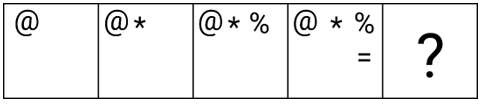
Identify the figure given in the options which when put in place of ? will logically complete the series.
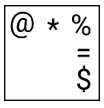
- (a)
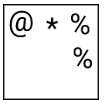
- (b)
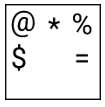
- (c)
- (d)
Answer
Why
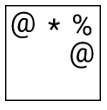
Correct — A. Rule: each box keeps every symbol the box before it held and adds one new one. The additions run left to right along the top row, then straight down the right-hand column.
Box 1 holds @. Box 2 adds *. Box 3 adds %, which fills the top row.
Box 4 has no room left on that row, so = drops into the right-hand column, directly beneath the %.
Box 5 must therefore carry @, *, % and =, plus one symbol not used before, sitting beneath the =.
Option (a) shows exactly that: @ * % across the top, = under the %, and $ under the =.
Why the others are wrong
- (b)This box shows @ * % with a second % beneath. It repeats a symbol instead of introducing a new one, and it loses the = that box 4 had already placed.
- (c)All five symbols are here, but the new $ sits at the left of the second row instead of under the =. Additions have been moving down the right-hand column since box 4.
- (d)A second @ appears under the %. Like option (b) it repeats an existing symbol and drops the =, leaving four symbols where box 5 needs five.
Concept
Symbol-accumulation series are read on two axes at once: what is added and where it goes.
What is added: one new symbol per box, everything earlier retained. Counting alone settles most options — the boxes hold 1, 2, 3 and 4 symbols, so box 5 holds 5.
Where it goes: the symbols trace a path through the cell. Here the path crosses the top row and then turns down the right-hand column, and that is what separates the two options carrying five symbols.
The series never reveals which symbol comes fifth, so the dollar sign cannot be predicted — only accepted. What the series does fix is that the fifth symbol is new and sits under the =, and just one option satisfies both conditions.
Key facts
- The four given boxes hold 1, 2, 3 and 4 symbols, so the fifth must hold 5.
- Every symbol once introduced is kept in all later boxes and never removed.
- The additions run left to right across the top row and then downward in the right-hand column.
Study next
Common traps
- Counting the symbols but not checking placement, which lets option (c) through
- Accepting a repeated symbol as though it were the new addition
- Trying to predict the next symbol instead of testing the four options against the rule
The figure-series stem also runs at 10 Sep 2024, 12:30, Reasoning Q.11 and at 17 Sep 2024, 9:00, Reasoning Q.3.
Related PYQs
No directly related past PYQ was found.