
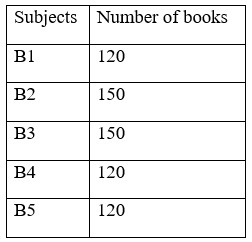
The given table shows the number of books on different subjects. What is the ratio of the number of books for subject B1 to the average number of books per subject?
- (a)3 : 5
- (b)2 : 5
- (c)10 : 11
- (d)4 : 5
Answer
Why
Correct — C. The table image lists five subjects: B1 = 120, B2 = 150, B3 = 150, B4 = 120, B5 = 120 books.
Total = 120 + 150 + 150 + 120 + 120 = 660
Average per subject = 660 ⁄ 5 = 132
Required ratio = B1 : average = 120 : 132
Divide both by 12: 10 : 11 → option (c)
Why the others are wrong
- (a)3 : 5 — 3 : 5 would need an average of 200 books per subject, but the five rows total only 660, so the mean is 132.
- (b)2 : 5 — 2 : 5 implies an average of 300 — more than double the true mean and higher than any single row in the table.
- (d)4 : 5 — 4 : 5 implies an average of 150. That is the B2 and B3 figure, not the mean of all five subjects.
Concept
This is table data interpretation with one derived quantity. The average number of books per subject is the plain mean of the five listed counts, so total first, then divide by 5.
Three subjects hold 120 books and two hold 150, so the mean has to lie between 120 and 150 — a sanity check worth two seconds before any division.
The last step is ratio hygiene: 120 : 132 is correct but not in lowest terms, and the options are. Both terms share 12, giving 10 : 11.
The table is supplied as an image; the numbers quoted here are read directly off it.
Key facts
- Total books across the five subjects = 660, so the average is 660 ÷ 5 = 132.
- 120 : 132 reduces by 12 to 10 : 11.
- The mean of a set always lies between its smallest and largest values, here between 120 and 150.
Study next
Common traps
- Dividing the total by 4 or 6 instead of the five subjects actually listed.
- Averaging only the distinct values 120 and 150 to get 135.
- Leaving the answer as 120 : 132 and failing to find it among the reduced options.
A table hands you more numbers than the question needs; this one wants a single derived figure, a ratio against a mean, so compute only that. The same shift's Quant Q.22 uses the average as a threshold instead, asking in how many years production beat it.
Related PYQs
No directly related past PYQ was found.