
Pipe L can fill a pool in 30 hours and pipe M in 45 hours. If both the pipes are opened in an empty pool, how much time will they take to fill it?
- (a)

- (b)

- (c)
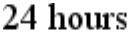
- (d)

Answer
Why
Correct — B. Add the rates, never the times.
Pipe L fills 1 ⁄ 30 of the pool in one hour
Pipe M fills 1 ⁄ 45 of the pool in one hour
Together: 1 ⁄ 30 + 1 ⁄ 45 = 3 ⁄ 90 + 2 ⁄ 90 = 5 ⁄ 90 = 1 ⁄ 18 per hour
Time = 1 ÷ (1 ⁄ 18) = 18 hours
Option (b) is the image reading 18 hours
Why the others are wrong
- (a)Option (a) reads 17 hours. Take the pool as 90 units: L does 3 units an hour, M does 2, together 5 — and 90 ÷ 5 is 18, not 17.
- (c)Option (c) reads 24 hours, which would mean a joint rate of 1 ⁄ 24 per hour. The two rates actually add to 1 ⁄ 18.
- (d)Option (d) reads 20 hours. At the joint rate of 1 ⁄ 18 the pool is already full at 18 hours, so 20 overshoots.
Concept
Pipes and cisterns is time-and-work with a tank. The unit of comparison is the fraction of the job done per hour, and those fractions add.
If one pipe needs a hours and another b hours, the pair needs ab ⁄ (a + b) hours: here 30 × 45 ⁄ 75 = 18.
The cleaner method for exam speed is the unit method. Take the tank as the LCM of the times — 90 units — so L delivers 3 units an hour and M delivers 2. Together they deliver 5, and 90 ÷ 5 = 18 hours, with no fractions anywhere.
The four options are printed as images rather than text. They read 17 hours, 18 hours, 24 hours and 20 hours for options (a), (b), (c) and (d) respectively.
Key facts
- Rates add, times do not: 1 ⁄ T = 1 ⁄ a + 1 ⁄ b.
- For two pipes the combined time is ab ⁄ (a + b), which is 30 × 45 ⁄ 75 = 18 hours here.
- Taking the tank as the LCM of the individual times turns the fractions into whole units.
Study next
Common traps
- Averaging the two times to 37.5 hours.
- Adding 30 and 45, or subtracting them, instead of adding the rates.
- Reaching 1 ⁄ 18 and forgetting to invert it, then answering with the fraction.
SSC alternates the wrapper between pipes filling a tank and workers finishing a job, but the procedure is fixed: convert to per-hour rates, add, invert at the end.
Related PYQs
No directly related past PYQ was found.