
Which of the following statements about the main features of the 'Jagadambi Temple' in Khajuraho is false?
- (a)This temple has both a half-mandapa and a verandah arranged within a single chamber.
- (b)This temple lacks a circumambulation path.
- (c)There is a colossal statue of Laxmi in the sanctorum.
- (d)A statue of Vishnu is installed at the main entrance of the sanctorum.
Correct — C, and it is the false statement, which is what the question asks for. The colossal image enshrined in the sanctum of the Devi Jagadamba (Jagadambi) temple is of the Devi — Parvati, worshipped today as Jagadamba — not of Lakshmi. The temple takes its very name from that image, so misnaming the goddess is the one clear error in the list. The other three statements describe the temple correctly, which is why they cannot be the answer.
- (a)This temple has both a half-mandapa and a verandah arranged within a single chamber. — A true statement about this temple, and therefore not the answer. Devi Jagadamba follows the simpler Khajuraho plan: it has no separate maha-mandapa with lateral transepts, so the ardha-mandapa (entrance porch) and the hall behind it run together as one continuous space.
- (b)This temple lacks a circumambulation path. — True — Devi Jagadamba is a nirandhara temple: there is no pradakshina passage wrapped around the sanctum. Its neighbours on the same platform, the Kandariya Mahadeva and the Lakshmana, are sandhara temples and do have that passage. This contrast is the single most examinable fact about the building.
- (d)A statue of Vishnu is installed at the main entrance of the sanctorum. — True — the lalata-bimba, the central block on the lintel of the sanctum doorway, carries an image of Vishnu. That is precisely why art historians hold that the shrine was originally a Vishnu temple, with the Devi image installed later; the statement records real evidence, not an error.
The Devi Jagadamba is one of the three temples standing on the great shared platform of the Western Group at Khajuraho, alongside the Kandariya Mahadeva and the small Mahadeva shrine, built under the Chandelas around the late tenth to early eleventh century. Khajuraho temples are classic Nagara work: a high jagati platform, a graded series of halls leading to the garbhagriha, and a shikhara built up from clustered miniature spires (urushringas). They divide by plan into sandhara temples, which have an ambulatory passage around the sanctum, and nirandhara temples, which do not. Devi Jagadamba is nirandhara, and its Vishnu image on the sanctum lintel points to an original Vaishnava dedication later overtaken by Devi worship.
Statement questions on monuments are won by holding one hard architectural fact plus one hard iconographic fact per building. For Devi Jagadamba those two are: no ambulatory (nirandhara), and the sanctum image is the Devi with Vishnu on the doorway lintel. Once those are locked, option (c) collapses immediately, because it swaps Lakshmi for Parvati — and the temple's name itself contradicts it. Note the family of look-alike names at Khajuraho that the setter can exploit: Lakshmana temple, Chausath Yogini, Matangeshwar, Devi Jagadamba.
- Devi Jagadamba (Jagadambi) temple, Western Group, Khajuraho — Chandela period, on the same platform as the Kandariya Mahadeva
- It is a nirandhara temple: no circumambulatory passage around the sanctum
- Sanctum image: a colossal figure of the Devi, worshipped as Jagadamba (Parvati)
- Vishnu appears on the lalata-bimba of the sanctum doorway — the basis for reading the shrine as originally Vaishnava
- Khajuraho Group of Monuments — UNESCO World Heritage Site since 1986; the Nagara style of temple architecture
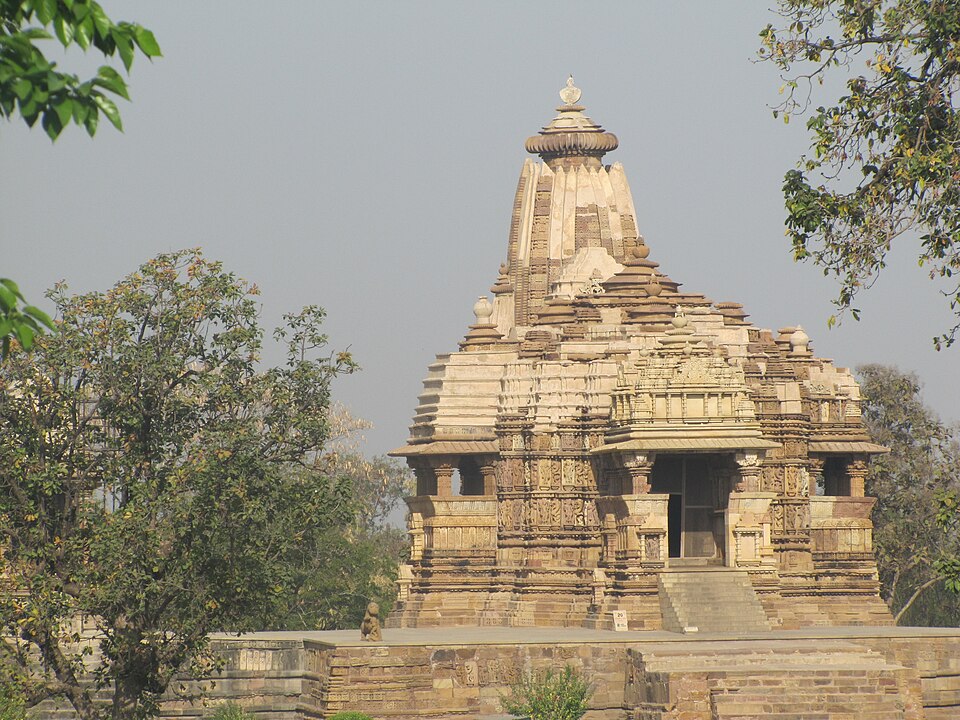
- Assuming Devi Jagadamba was always a goddess temple; the Vishnu lintel points to an original Vaishnava dedication
- Assuming every Khajuraho temple has a pradakshina path — Kandariya Mahadeva and Lakshmana do, Devi Jagadamba does not
- Confusing the goddess of the sanctum (Parvati/Jagadamba) with Lakshmi, or the temple with the nearby Lakshmana temple, which is Vaishnava and named after a Chandela king's shrine, not the goddess
MPPSC's signature format for MP monuments is 'which statement is false', which punishes vague familiarity — you must own one exact feature. UPSC comes at Khajuraho from outside the building: dynasty-to-site matching (Chandella : Khajuraho), the region it belongs to (Bundelkhand), or pure style theory (Nagara, Dravida, Vesara).
Match List I with List II and select the correct answer using the code given below the lists: List I I. Gupta II. Chandella III. Chalukya IV. Pallava List II A) Badami B) Panamalai C) Khajuraho D) Deogarh Codes:
- (a) I–D, II–C, III–A, IV–B
- (b) I–D, II–B, III–C, IV–A
- (c) I–B, II–C, III–D, IV–A
- (d) I–C, II–D, III–A, IV–B
Answer(a) I–D, II–C, III–A, IV–B
The same monument seen from the dynasty side — Khajuraho as the Chandella contribution to temple building, the context in which the Devi Jagadamba was raised.
The Nagara, the Dravida and the Vesara are the
- (a) three main racial groups of the Indian subcontinent
- (b) three main linguistic divisions into which the languages of India can be classified
- (c) three main styles of Indian temple architecture
- (d) three main musical Gharanas prevalent in India
Answer(c) three main styles of Indian temple architecture
The vocabulary layer beneath this question: Khajuraho is the textbook example of the Nagara style, and terms like sandhara and nirandhara belong to that same descriptive system.
Where is the historical Matangeshwar temple situated?
- (a) Ujjain
- (b) Maheshwar
- (c) Khajuraho
- (d) Vidisha
Answer(c) Khajuraho
MPPSC works its way temple by temple through Khajuraho; knowing the individual shrines by name — Matangeshwar, Devi Jagadamba, Kandariya Mahadeva, Chausath Yogini — is what these questions actually test.
Where is the Matangeshwar temple located in Madhya Pradesh ?
- (a) Mandu
- (b) Chitrakoot
- (c) Tripuri
- (d) Khajuraho
Answer(d) Khajuraho
The commission repeated the identical Khajuraho question two years running before moving, in 2026, to the internal features of one of its temples — clear evidence of how heavily this site is farmed.
- practice — not a real PYQ
The temples of Khajuraho were built mainly under which dynasty?
- (a)Paramara
- (b)Chandela
- (c)Kalachuri
- (d)Gurjara-Pratihara
Answer(b) Chandela — the Chandelas of Jejakabhukti (Bundelkhand) built the Khajuraho group between roughly 950 and 1050 CE. - practice — not a real PYQ
In Indian temple architecture, a 'nirandhara' temple is one which
- (a)has no shikhara over the sanctum
- (b)has no circumambulatory passage around the sanctum
- (c)has no mandapa in front of the sanctum
- (d)is not raised on a platform
Answer(b) has no circumambulatory passage around the sanctum — the opposite type, with such a passage, is called sandhara.