
Which of the following sites in Madhya Pradesh is recognized as a 'World Heritage Site'?
- (a)The historical group of Orchha
- (b)The Sanchi Stupa
- (c)The Satpura Tiger Reserve
- (d)The Bhojeshwar Temple Complex
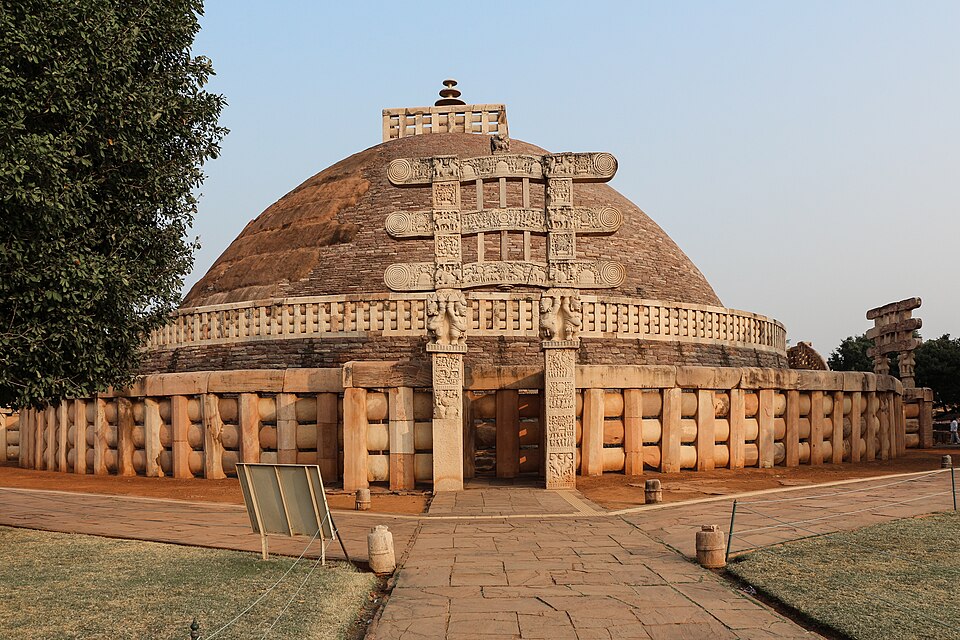
Correct — B, the Sanchi Stupa. The 'Buddhist Monuments at Sanchi', in Raisen district, were inscribed on the UNESCO World Heritage List in 1989. Madhya Pradesh has exactly three inscribed World Heritage properties — the Khajuraho Group of Monuments (1986), the Buddhist Monuments at Sanchi (1989) and the Rock Shelters of Bhimbetka (2003) — and Sanchi is the only one of the four names offered here. The site is valued as the most complete surviving ensemble of early Buddhist stupas, pillars, monasteries and temples, in continuous use from the third century BCE to the twelfth century CE.
- (a)The historical group of Orchha —
- (c)The Satpura Tiger Reserve — A tiger reserve in Narmadapuram district and a serious natural-heritage candidate that figures on India's Tentative List, but it is not inscribed. India's natural World Heritage properties are elsewhere — Kaziranga, Manas, Sundarbans, Keoladeo, Nanda Devi and Valley of Flowers, Great Himalayan National Park and the Western Ghats.
- (d)The Bhojeshwar Temple Complex — The unfinished eleventh-century Shiva temple at Bhojpur near Bhopal, built under the Paramara king Bhoja and famous for one of the largest lingas in India, is likewise a Tentative List entry — architecturally extraordinary, but not an inscribed World Heritage Site.
World Heritage status is conferred under the 1972 UNESCO Convention Concerning the Protection of the World Cultural and Natural Heritage. The route has two steps: a State Party first places a property on its own Tentative List, and only a property already on that list can be formally nominated; the World Heritage Committee then decides on the basis of Outstanding Universal Value against ten criteria (i–vi cultural, vii–x natural). In India, cultural nominations are steered by the Archaeological Survey of India and natural ones by the Ministry of Environment, Forest and Climate Change. Properties that meet both cultural and natural criteria are 'mixed' — Khangchendzonga National Park is India's only one.
This question is built on the single most common misunderstanding in heritage questions: candidates treat 'on the Tentative List' as 'is a World Heritage Site'. All three wrong options are real, celebrated MP sites that sit on that list, which is why they feel right. The safe strategy is to hold MP's three inscribed sites — Khajuraho, Sanchi, Bhimbetka — as a closed set, and treat everything else in the state as tentative until UNESCO says otherwise.
- Buddhist Monuments at Sanchi — inscribed on the World Heritage List in 1989; Raisen district, Madhya Pradesh
- Madhya Pradesh's three World Heritage Sites: Khajuraho (1986), Sanchi (1989), Rock Shelters of Bhimbetka (2003)
- The Great Stupa (Stupa 1) at Sanchi: brick core built under Ashoka, enlarged in the Sunga period, the four carved toranas added under the Satavahanas
- Orchha, Satpura Tiger Reserve and the Bhojeshwar temple at Bhojpur appear on India's UNESCO Tentative List — candidates, not inscriptions
- Khangchendzonga National Park is India's only 'mixed' (cultural and natural) World Heritage Site
- Equating the Tentative List with World Heritage status — the commonest error in this whole topic
- Confusing UNESCO listing with domestic tags such as 'ASI Monument of National Importance' or a state heritage notification
- Mixing UNESCO's World Heritage list with the Ramsar list (wetlands, a different convention) or Biosphere Reserves (Man and the Biosphere programme)
MPPSC asks 'which MP site is a World Heritage Site' or the ancient name / builder of Sanchi. UPSC prefers list-based versions — which of these properties are inscribed, or how many were added in a particular year (2005, 2009, 2024).
Consider the following statements: 1. Champaner - Pavagadh Archaeological Park 2. Chhatrapati Shivaji Railway Station, Mumbai 3. Mamallapuram 4. Sun Temple (Konark Temple) Which of the above are included in the World Heritage List of UNESCO?
- (a) 1, 2 and 3
- (b) 1, 3 and 4
- (c) 2 and 4
- (d) 1, 2, 3 and 4
Answer(d) 1, 2, 3 and 4
Exactly the same discrimination — separating properties actually inscribed on the World Heritage List from famous monuments that merely feel as though they should be.
Consider the following properties included in the World Heritage List released by UNESCO: 1. Shantiniketan 2. Rani-ki-Vav 3. Sacred Ensembles of the Hoysalas 4. Mahabodhi Temple Complex at Bodhgaya How many of the above properties were included in 2023?
- (a) Only one
- (b) Only two
- (c) Only three
- (d) All four
Answer(b) Only two
The modern UPSC version — it is no longer enough to know that a site is inscribed; you are expected to know the year of inscription, exactly as Sanchi 1989 / Khajuraho 1986 / Bhimbetka 2003 must be held for Madhya Pradesh.
Which among the following Stupa gateway depicts the pilgrimage to the Bodhi tree by Ashoka with his two queens?
- (a) Bharhut
- (b) Sanchi
- (c) Sonari
- (d) Satdhara
Answer(b) Sanchi
The same monument from the art side — the torana reliefs of the Great Stupa. MPPSC returns to Sanchi every few years, which makes it the single highest-yield site in MP's cultural syllabus.
- practice — not a real PYQ
The Rock Shelters of Bhimbetka, a UNESCO World Heritage Site, are located in which district of Madhya Pradesh?
- (a)Raisen
- (b)Sehore
- (c)Vidisha
- (d)Chhatarpur
Answer(a) Raisen — Bhimbetka lies in Raisen district, the same district that contains Sanchi. - practice — not a real PYQ
The elaborately carved toranas (gateways) of the Great Stupa at Sanchi are generally assigned to which period?
- (a)Mauryan
- (b)Sunga
- (c)Satavahana
- (d)Gupta
Answer(c) Satavahana — the stupa's core is Mauryan and the stone railings are Sunga work, but the four carved gateways belong to the Satavahana period (about the first century BCE).