
Indal puja is related to which tribe of Madhya Pradesh?
- (a)Barela
- (b)Gond
- (c)Baiga
- (d)Sahariya
Correct — A, Barela. 'Indal' (also written Indar) is the tribal form of the name Indra, the rain-giving deity, and Indal puja is the great vow-fulfilment worship of the Barela — a Bhil sub-group of the Nimar belt of western Madhya Pradesh (Barwani, Khargone, Khandwa), who share the ritual with the closely related Bhilala. The word names both the god and the event. Indal, performed by a single household, and gaon Indal, performed by an entire village — the first typically when a family's distress has passed, the second in a spell of peace and plenty, so the worship is tied to rain, harvest and thanksgiving rather than to a fixed calendar date.
- (b)Gond — The Gond are the largest tribe of Madhya Pradesh, of the Mahakoshal–Satpura belt (Mandla, Dindori, Chhindwara, Betul, Seoni). Their ritual life centres on Bada Dev (Budha Dev) and MPPSC has keyed the Mandwara festival and the Birha folk song to them — but Indal is not part of the Gond round.
- (c)Baiga — A Particularly Vulnerable Tribal Group of the eastern districts (Dindori, Mandla, Balaghat, Shahdol), known for bewar shifting cultivation and godna tattooing. Their observances belong to the eastern forest belt, not to the Bhil cluster of the Narmada's western valley where Indal is performed.
- (d)Sahariya — A PVTG of the Gwalior-Chambal region (Sheopur, Shivpuri, Guna, Morena), whose livelihood leans on forest produce. They live at the opposite corner of the state from the Nimar Indal belt.
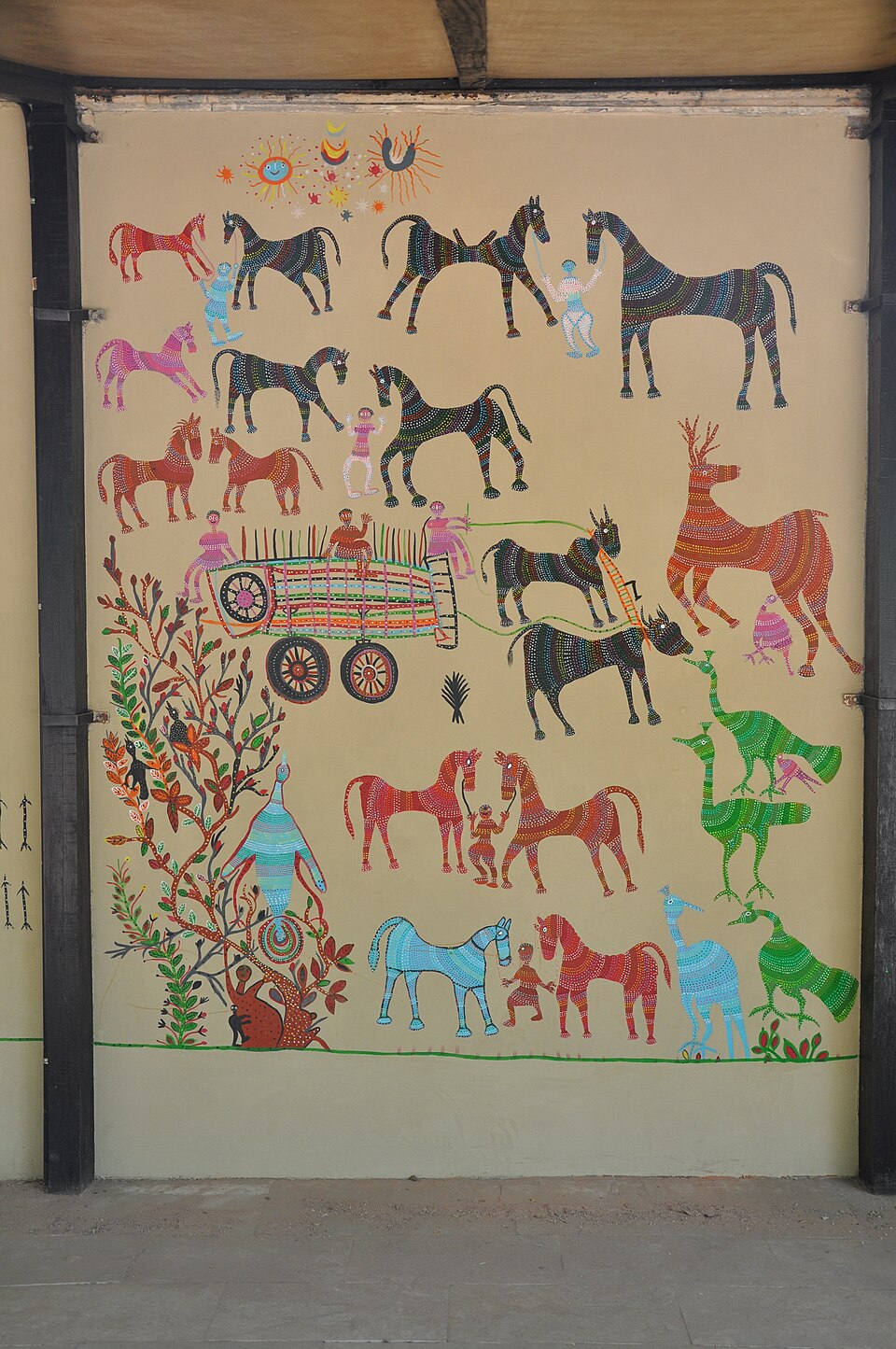
Western Madhya Pradesh — Jhabua, Alirajpur, Dhar, Barwani, Khargone, Khandwa — is the Bhil belt, and the Bhil, Bhilala, Barela and Patelia of that belt form one cultural cluster whose religion braids pan-Indian deities into local worship. Indal is the clearest case: Indra becomes Indar becomes Indal, a god of rain and of the good season, honoured not on a fixed festival date but when a vow falls due. The same cluster gives Madhya Pradesh the Bhagoria haat festival in the week before Holi and the Pithora wall paintings made by ritual painters on a household's inner wall after a vow is fulfilled.
MPPSC's single most repeated tribal-culture pattern is 'ritual, dance, song or craft ↔ tribe'. The efficient way to prepare is not to memorise isolated pairs but to build two regional bundles. West (Bhil–Bhilala–Barela, Nimar–Jhabua): Indal puja, Bhagoria, Pithora painting, Gal/Gair-type dances. East and centre (Gond–Baiga, Mahakoshal–Vindhya): Bada Dev worship, Karma dance, godna tattoos, Gudum Baja. Once the map is in place, an unfamiliar name like 'Indal' can be placed by its sound and its god — Indra, rain, a farming belt — long before the option list is read.
- Indal = Indar = Indra; Indal puja is a rain-and-harvest worship of the Barela–Bhilala–Bhil cluster of western Madhya Pradesh
- The word denotes both the deity and the ritual event
- Indal is a vow-fulfilment worship, performed at multi-year intervals as a household or village can afford it
- The Barela are a Bhil sub-group of the Nimar belt — Barwani, Khargone, Khandwa
- The same cluster celebrates Bhagoria, the haat festival of the week before Holi, across Jhabua, Alirajpur, Dhar, Barwani and Khargone
- Answering 'Gond' by default because it is the largest tribe of the state — MPPSC often keys the smaller, region-specific community
- Confusing the western Bhil cluster (Bhil, Bhilala, Barela, Patelia) with the eastern Gond–Baiga cluster
- Treating Barela as an independent tribe unrelated to the Bhil — it is a Bhil sub-group
MPPSC asks a straight one-line pairing — festival, ritual, dance, song, craft or ornament to tribe. UPSC asks the same relationship as a matched-pairs set ('Traditions — Communities') where one deliberately mismatched pair decides the answer.
Consider the following pairs: Traditions — Communities 1. Chaliha Sahib Festival — Sindhis 2. Nanda Raj Jaat Yatra — Gonds 3. Wari-Warkari — Santhals Which of the pairs given above is/are correctly matched?
- (a) 1 only
- (b) 2 and 3 only
- (c) 1 and 3 only
- (d) None of the above
Answer(a) 1 only — the Nanda Raj Jaat belongs to Uttarakhand and Wari-Warkari to Maharashtra, so pairs 2 and 3 are mismatched.
Exactly the ritual-to-community mapping MPPSC asks here, in UPSC's matched-pairs format — and it plants 'Gonds' as a wrong pairing, the same default trap.
Every year, a month-long ecologically important campaign/festival is held during which certain communities/tribes plant saplings of fruit-bearing trees. Which of the following are such communities/tribes?
- (a) Bhutia and Lepcha
- (b) Gond and Korku
- (c) Irula and Toda
- (d) Sahariya and Agariya
Answer(b) Gond and Korku
A festival-to-tribe question set in central India, with Madhya Pradesh communities in three of the four options — the same regional bundling this card recommends.
Mandwara festival is celebrated by the:
- (a) Gond
- (b) Baiga
- (c) Bharia
- (d) Sahariya
Answer(a) Gond
Same question type one cycle earlier — a named observance matched to a Madhya Pradesh tribe, with the same four-tribe option set.
“Nohdora” ornamentation made of clay on the wall is the speciality of which tribe?
- (a) Bhil
- (b) Korku
- (c) Saharia
- (d) Gond
Answer(d) Gond
A cultural practice tied to one tribe, asked with the same distractor pool — evidence that MPPSC drills this pairing year after year.
- practice — not a real PYQ
Bhagoria, the week-long haat festival held just before Holi, is celebrated mainly by which communities of western Madhya Pradesh?
- (a)Gond and Baiga
- (b)Bhil, Bhilala and Barela
- (c)Sahariya and Kol
- (d)Korku and Bharia
Answer(b) Bhil, Bhilala and Barela — across Jhabua, Alirajpur, Dhar, Barwani and Khargone districts. - practice — not a real PYQ
In the ritual vocabulary of the tribes of western Madhya Pradesh, 'Indal' is a local form of which deity?
- (a)Indra
- (b)Varuna
- (c)Agni
- (d)Rudra
Answer(a) Indra — Indra becomes Indar and then Indal, worshipped as the giver of rain and a good season.