
In which inscription is the mention of Bharatvarsha found?
- (a)Ayodhya Inscription of Dhandeva
- (b)Iron Pillar Inscription of Mehrauli
- (c)Garudadhwaja Inscription of Besnagar
- (d)Hathigumpha Inscription of Kharavela
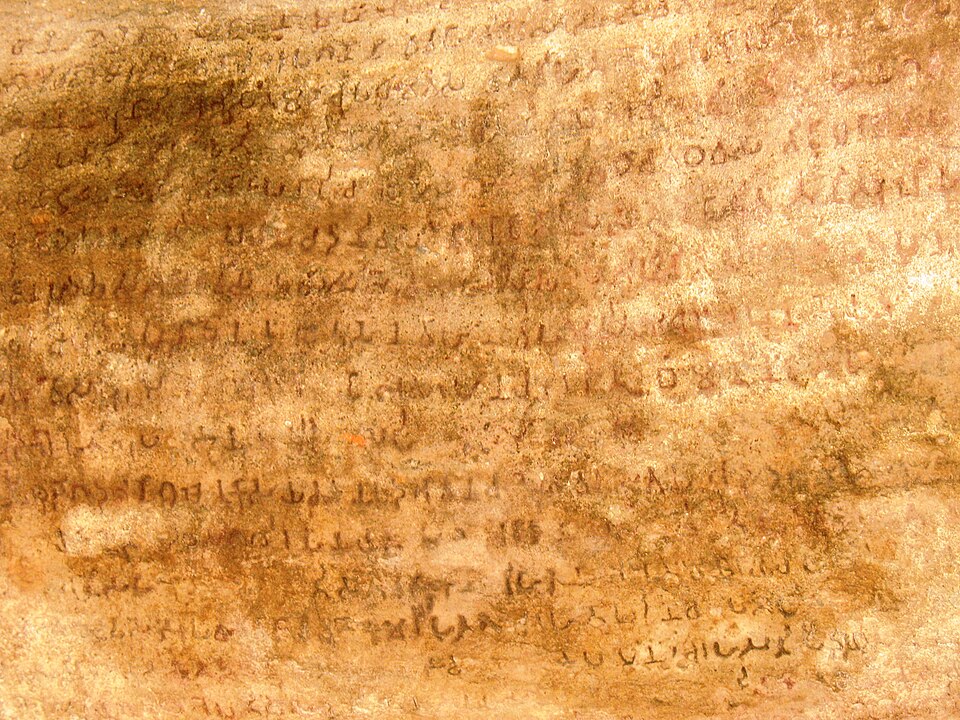
Correct — D, the Hathigumpha inscription of Kharavela. Carved in the Hathigumpha ('elephant cave') in the Udayagiri hills near Bhubaneswar in Odisha, this seventeen-line Prakrit record in Brahmi script gives a year-by-year account of the reign of Kharavela, the Chedi (Mahameghavahana) king of Kalinga in about the 1st century BCE. Among his campaigns the record speaks of an army despatched to Bharadhavasa — Bharatavarsha — which is why this inscription is regularly cited as one of the earliest epigraphic occurrences of the name Bharatvarsha.
- (a)Ayodhya Inscription of Dhandeva — The Ayodhya inscription of Dhanadeva, a king of Kosala, is famous for something else — it records that he was descended from Pushyamitra Sunga, who performed two ashvamedha sacrifices. It carries no mention of Bharatvarsha.
- (b)Iron Pillar Inscription of Mehrauli — The Sanskrit verse on the iron pillar now at the Qutb complex, Mehrauli, praises a king named Chandra (usually identified with Chandragupta II) for his conquests and his devotion to Vishnu; it does not use the term Bharatvarsha.
- (c)Garudadhwaja Inscription of Besnagar — The Garuda pillar at Besnagar (Vidisha, Madhya Pradesh) records that Heliodorus, the Greek envoy of Antialkidas sent to king Kasiputra Bhagabhadra, set it up as a Bhagavata devotee of Vasudeva — a landmark for early Vaishnavism, not for the name Bharatvarsha.
Inscriptions are the hardest evidence early Indian history has: they are dated, they are contemporary, and they cannot be re-edited by later copyists. Because of this, prelims papers tend to test one thing per inscription — the single fact for which each record is famous. The Hathigumpha inscription is a prashasti, a eulogy of Kharavela of Kalinga, and it is quoted for three things: his patronage of Jainism (he brought back a Jina image that a Nanda king had carried off), his repair of an old Nanda-era canal, and his use of the term Bharadhavasa (Bharatavarsha).
The way in is to run down the list and recall what each record is actually famous for: Ayodhya–Dhanadeva → Pushyamitra's two horse-sacrifices; Mehrauli iron pillar → king Chandra and rust-resistant iron; Besnagar → Heliodorus, a Greek who became a Vaishnava. That leaves Hathigumpha, and Hathigumpha's own three-fact bundle includes Bharatvarsha. Note that MPPSC has a documented taste for this exact drill — it asked in 2019 which inscription mentions a silk-weavers' guild, with Hathigumpha planted among the options.
- Hathigumpha inscription: 17 lines in Prakrit, Brahmi script, in the Udayagiri hills near Bhubaneswar, Odisha; c. 1st century BCE
- It eulogises Kharavela of the Mahameghavahana (Chedi) dynasty of Kalinga, a patron of Jainism, and carries the much-cited reference to Bharadhavasa (read as Bharatavarsha, though the damaged passage is disputed)
- Ayodhya inscription of Dhanadeva: records that Pushyamitra Sunga performed two ashvamedha sacrifices
- Besnagar Garuda pillar: set up by Heliodorus, Greek ambassador of Antialkidas, who calls himself a Bhagavata — early evidence of Vasudeva worship
- Mehrauli iron pillar: Sanskrit eulogy of king Chandra, generally identified with Chandragupta II
- Assuming Bharatvarsha must first appear in a Gupta-period record because the Guptas are the 'classical' age
- Mixing the Ayodhya inscription of Dhanadeva (Pushyamitra's ashvamedhas) with the Besnagar pillar (Heliodorus)
- Confusing Hathigumpha in Odisha with the Barabar caves in Bihar — both are early rock-cut sites with inscriptions
Both commissions ask 'which inscription mentions X' or its mirror 'this inscription is known for what'. MPPSC leans on Madhya Pradesh records (Dashpur, Sondani, Besnagar) and Hathigumpha; UPSC prefers pairing a ruler with a record, or an edict with its content.
With reference to ancient Jainism, which one of the following statements is correct?
- (a) Jainism was spread in South India under the leadership of Sthalabahu
- (b) The Jains who remained under the leadership of Bhadrabahu were called Svetambaras after the Council held at Pataliputra
- (c) Jainism enjoyed the patronage of the Kalinga king Kharavela in the first century BC
- (d) In the initial stage of Jainism, the Jains worshipped images unlike Buddhists
Answer(c) Jainism enjoyed the patronage of the Kalinga king Kharavela in the first century BC
The correct statement here rests on the very same inscription — Kharavela's patronage of Jainism is known because the Hathigumpha record says so.
Which one of the following ancient Indian records is the earliest royal order to preserve food grains to be utilised during the crises in the country?
- (a) Sohagaura Copper-plate
- (b) Rumminidei pillar-edict of Asoka
- (c) Prayaga-Prasasti
- (d) Mehrauli Pillar inscription of Chandra
Answer(a) Sohagaura Copper-plate
The same drill — match an early record to the one thing it is famous for — and it uses the Mehrauli pillar of Chandra as a distractor exactly as MPPSC does here.
Consider the following pairs: Site — Well known for 1. Besnagar — Shaivite cave shrine 2. Bhaja — Buddhist cave shrine 3. Sittanavasal — Jain cave shrine How many of the above pairs are correctly matched?
- (a) Only one
- (b) Only two
- (c) All three
- (d) None
Answer(b) Only two — the Besnagar pair is the wrong one, since the site is known for the Heliodorus (Garuda) pillar.
Tests the very knowledge needed to strike out option (c) here: what Besnagar is actually famous for.
- practice — not a real PYQ
The Hathigumpha inscription of Kharavela is located in:
- (a)the Udayagiri hills near Bhubaneswar, Odisha
- (b)the Barabar hills, Bihar
- (c)Junagadh, Gujarat
- (d)Nagarjunakonda, Andhra Pradesh
Answer(a) the Udayagiri hills near Bhubaneswar — the cave sits in the Udayagiri–Khandagiri group of Jain caves. - practice — not a real PYQ
The Garuda pillar inscription at Besnagar (Vidisha) is historically important because it records:
- (a)a Greek envoy's devotion to Vasudeva
- (b)Ashoka's remorse after the Kalinga war
- (c)the two ashvamedha sacrifices of Pushyamitra Sunga
- (d)a land grant to a Buddhist monastery
Answer(a) a Greek envoy's devotion to Vasudeva — Heliodorus, ambassador of Antialkidas, describes himself as a Bhagavata.