
The depiction of Krishna and Balarama is found on the coins of which Indo-Greek ruler?
- (a)Menandar
- (b)Demetrius
- (c)Agathokleis
- (d)Eucratides
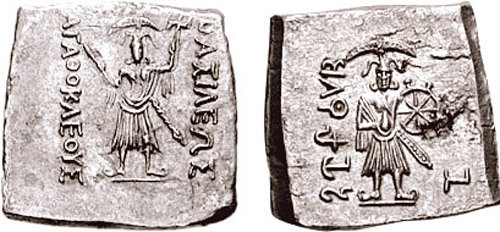
Correct — C, Agathokleis (Agathocles), the Greek king of Bactria/north-west India of the early second century BCE. Silver coins of his, found at Ai-Khanoum in northern Afghanistan, show on one face a deity holding a chakra (discus) and a conch — Vasudeva-Krishna — and on the other a deity with a plough and a club or mace — Samkarshana-Balarama. These are the earliest datable images of the two brothers anywhere, and they make Agathocles the most 'Indianising' of the Indo-Greek kings: he is also the ruler who issued coins with Brahmi legends, at a time when Greek and Kharoshthi were the usual scripts on such issues.
- (a)Menandar — Menander (Milinda) is the most famous Indo-Greek king, but his associations are Buddhist — the Milindapanho dialogue with the monk Nagasena — and his coins carry Athena Alkidemos and, on some issues, a wheel; not Krishna and Balarama.
- (b)Demetrius — Demetrius of Bactria is remembered for pushing Greek rule into north-west India and for the elephant-scalp headdress on his coin portraits; his issues do not carry the two Vrishni deities.
- (d)Eucratides — Eucratides' coins famously show the Dioscuri — the Greek twin horsemen Castor and Pollux — a pair of divine brothers that is easy to mistake for Krishna and Balarama, but they are Greek deities, not Indian ones.
Indo-Greek coins are among the most useful documents of post-Mauryan history: they carry the king's portrait and name, so they yield a king-list no text preserves, and their bilingual legends (Greek with Kharoshthi, and on some Agathocles issues Brahmi) helped scholars read early Indian scripts. They also record religious cross-over in both directions — Agathocles striking Vasudeva-Krishna and Samkarshana-Balarama, Menander associated with Buddhism, and Heliodorus, envoy of the Indo-Greek king Antialkidas, calling himself a Bhagavata on the Garuda pillar he raised at Besnagar near Vidisha in Madhya Pradesh.
The default reflex on any Indo-Greek question is 'Menander', and that reflex is exactly what this question punishes. Sort the kings by what each is famous for: Demetrius — the invasion; Menander — Buddhism and the Milindapanho; Eucratides — the Dioscuri and the huge gold coin; Agathocles — Brahmi legends and the Krishna-Balarama images. Note also that the Greeks' devotion to Vasudeva is attested twice over — once on Agathocles' coins and once, in Madhya Pradesh, on the Heliodorus pillar.
- Agathocles' coins from Ai-Khanoum show Vasudeva-Krishna with chakra and conch, and Samkarshana-Balarama with plough (hala) and club/mace
- They are the earliest known datable depictions of Krishna and Balarama — early second century BCE
- Agathocles is notable for issues with Brahmi legends, where Indo-Greek coins normally used Greek with Kharoshthi
- The Heliodorus (Garuda) pillar at Besnagar near Vidisha, Madhya Pradesh, was set up by Heliodorus, envoy of the Indo-Greek king Antialkidas to the Shunga king Bhagabhadra, who describes himself as a Bhagavata
- The Indo-Greeks were the first rulers in India to issue coins that can be definitely attributed to named kings, carrying the ruler's portrait
- Answering 'Menander' by reflex for every Indo-Greek question — he belongs with Buddhism
- Confusing the Dioscuri twins on Eucratides' coins with Krishna and Balarama
- Assuming Krishna imagery must begin in the Gupta period — the coin and inscriptional evidence is second century BCE
MPPSC asks the direct 'whose coins / which ruler' identification. UPSC prefers pairs and statement sets — ruler matched with religion, or site matched with what it is known for. Lock the trio: Agathocles ↔ Krishna-Balarama coins; Menander ↔ Milindapanho; Antialkidas/Heliodorus ↔ the Besnagar Garuda pillar.
The Indo-Greek kingdom set up in north Afghanistan in the beginning of the second century BC was
- (a) Bactria
- (b) Scythia
- (c) Zedrasia
- (d) Aria
Answer(a) Bactria
The same kingdom and the same moment — Agathocles ruled in this Bactrian/north-Afghan zone, and Ai-Khanoum, where the Krishna-Balarama coins were found, lies in it.
Milindapanho is in the form of a dialogue between the King Menander and the Buddhist monk
- (a) Nagasena
- (b) Nagarjuna
- (c) Nagabhatta
- (d) Kumarilabhatta
Answer(a) Nagasena
Tests the other half of the same theme — which Indo-Greek king went with which Indian religion; it fixes Menander (option A here) to Buddhism, leaving Agathocles with the Vaishnava coins.
- practice — not a real PYQ
The Heliodorus pillar at Besnagar (near Vidisha, Madhya Pradesh) was erected in honour of:
- (a)Vasudeva
- (b)Shiva
- (c)the Buddha
- (d)Mahavira
Answer(a) Vasudeva — Heliodorus, the Greek envoy of Antialkidas, raised the Garuda pillar and called himself a Bhagavata, making it key evidence for early Vaishnavism. - practice — not a real PYQ
Which one of the following statements about the Indo-Greeks is correct?
- (a)They were the first rulers in India to issue coins that can be definitely attributed to individual kings
- (b)They ruled the Gangetic plains from Pataliputra
- (c)They introduced the purest gold coinage seen in ancient India
- (d)They used only the Brahmi script on their coins
Answer(a) They were the first rulers in India to issue coins definitely attributable to named kings — earlier punch-marked coins carry no ruler's name; large-scale gold coinage came with the Kushanas and Guptas.