
Which Indian Communication satellite, launched in the early 1980s, became the first fully operational satellite of the INSAT series and significantly strengthened India's telecommunication and broadcasting services?
- (a)INSAT-1A — 10th April, 1982
- (b)INSAT-1B — 30th August, 1983
- (c)IRS-1A — 17th March, 1988
- (d)APPLE — 19th June, 1981
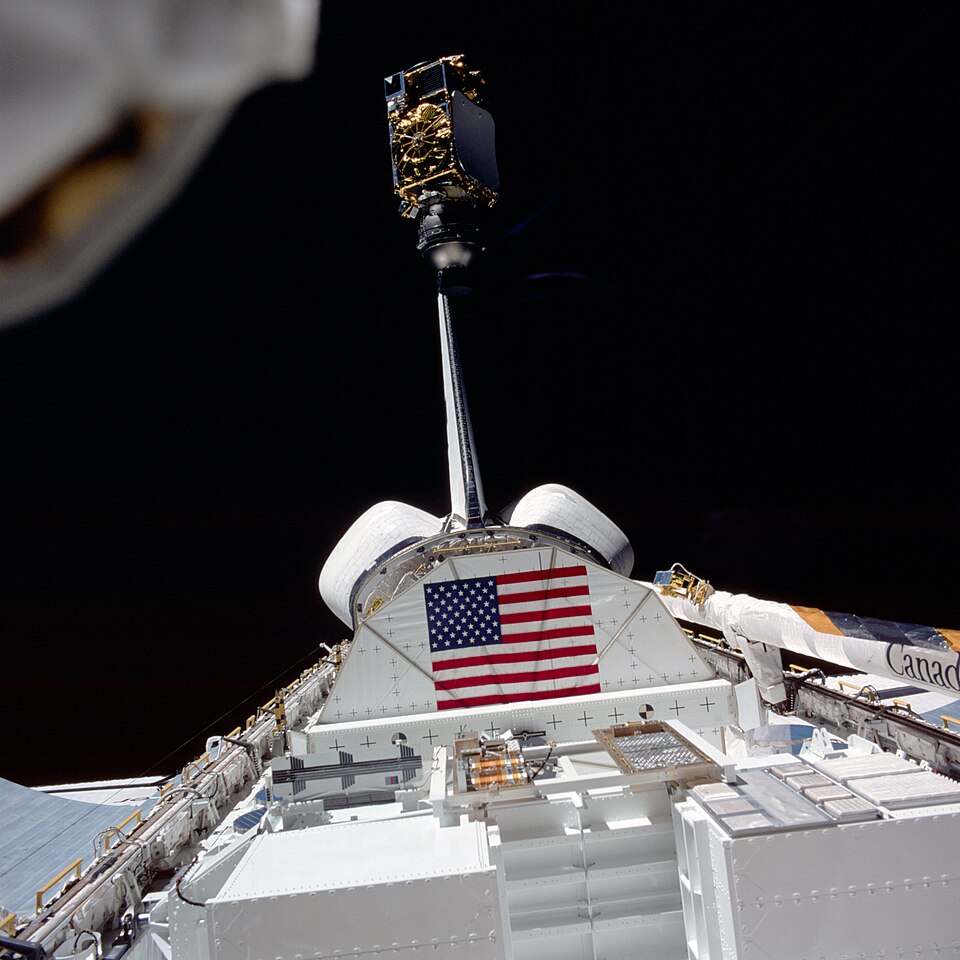
Correct — B, INSAT-1B (30 August 1983). INSAT-1A, the first satellite of the series, was launched in April 1982 but ran into in-orbit failures and was abandoned within months, so the first fully operational INSAT was INSAT-1B, deployed from the US Space Shuttle Challenger on mission STS-8 in August 1983. Because INSAT-1B was a multipurpose geostationary satellite carrying telecommunication, television/radio broadcasting and meteorological payloads on a single platform, it drove the mid-1980s expansion of national TV and radio coverage, long-distance telephony and cyclone warning in India.
- (a)INSAT-1A — 10th April, 1982 — The date is right — INSAT-1A was launched on 10 April 1982 — but it was the failure of the series, not its workhorse. It developed problems in orbit and was given up within months, so it never became the fully operational satellite the question describes.
- (c)IRS-1A — 17th March, 1988 — IRS-1A was India's first operational remote-sensing (Earth observation) satellite, launched in 1988 from Baikonur. It belongs to the IRS series, not INSAT, and it is not a communication satellite at all.
- (d)APPLE — 19th June, 1981 — APPLE (Ariane Passenger Payload Experiment) was India's first experimental geostationary communication satellite, launched by Ariane-1 in June 1981. It was a technology demonstrator that proved India could build and operate a three-axis-stabilised geostationary satellite — it was never an operational INSAT-series satellite.
INSAT (Indian National Satellite System) is India's multipurpose geostationary satellite system — one platform serving telecommunications, television and radio broadcasting, and meteorology at the same time. It is jointly used by the Department of Space, the Department of Telecommunications, the India Meteorological Department, All India Radio and Doordarshan. Geostationary satellites sit about 36,000 km above the equator and complete one orbit in a day, so they appear fixed in the sky — which is why a dish antenna on the ground can be pointed once and left alone.
The trap is that all four options carry real satellites with real dates, so the question is not about the date — it is about the word 'operational'. INSAT-1A was launched first but failed; INSAT-1B was the one that actually worked. Fix the pair in memory as 'first launched ≠ first operational'.
- INSAT-1A: launched 10 April 1982; failed in orbit and was abandoned the same year
- INSAT-1B: launched 30 August 1983 from the Space Shuttle Challenger (mission STS-8) — the first fully operational INSAT
- INSAT is multipurpose: telecommunications + TV/radio broadcasting + meteorology on one geostationary platform
- APPLE (1981) was the experimental communication-satellite precursor; IRS-1A (1988) started the separate remote-sensing series
- Geostationary orbit is about 36,000 km above the equator, with an orbital period of roughly 24 hours
- Mixing up INSAT-1A (launched first, failed) with INSAT-1B (first fully operational)
- Treating IRS satellites as communication satellites — they are remote-sensing/Earth-observation
- Assuming India's early satellites were launched on Indian rockets — the INSAT-1 satellites were launched by US vehicles and APPLE by Europe's Ariane
State PCS papers ask it as a direct 'which satellite/series' recall; UPSC prefers statement-based versions ('all INSAT satellites were launched abroad', 'PSLV launched the IRS series') that test the same distinctions between series, purpose and launcher.
INSAT-3E, India’s communication satellite, was launched in 2003 from
- (a) French Guiana
- (b) Seychelles
- (c) Mauritius
- (d) Mauritania
Answer(a) French Guiana
Same concept — an INSAT-series communication satellite and where it was launched from, reinforcing that early INSAT satellites went up on foreign launch vehicles.
With reference to Indian satellites and their launchers, consider the following statements: 1. All the INSAT-series of satellites were launched abroad 2. PSLVs were used to launch IRS-series of satellites 3. India used the indigenously built cryogenic engines for the first time for powering the third stage of GSLV 4. GSAT, launched in the year 2001, has payloads to demonstrate digital broadcasts and internet services Which of these statements are correct?
- (a) 1, 2, 3 and 4
- (b) 2, 3 and 4
- (c) 1, 2 and 4
- (d) 1 and 3
Answer(c) 1, 2 and 4
Tests the same INSAT-versus-IRS distinction and the fact that INSAT satellites were launched abroad — the very reason INSAT-1B flew on a US Space Shuttle.
- practice — not a real PYQ
APPLE, launched in June 1981, is best described as:
- (a)India's first experimental geostationary communication satellite
- (b)India's first remote-sensing satellite
- (c)India's first navigation satellite
- (d)India's first dedicated military satellite
Answer(a) India's first experimental geostationary communication satellite — the Ariane Passenger Payload Experiment, a technology demonstrator that preceded the operational INSAT series. - practice — not a real PYQ
Communication satellites are placed in geostationary orbit mainly because at that orbit a satellite:
- (a)completes one revolution in about 24 hours and so appears stationary above a point on the equator
- (b)escapes the Earth's gravity completely
- (c)can photograph the Earth's surface at the highest possible resolution
- (d)passes over both poles on every orbit
Answer(a) Its orbital period matches the Earth's rotation, so it appears fixed in the sky and ground antennas need not track it.